
- What Does Removing Obstacles in Communicating with a Child Mean
- When Is a Parent’s Right to Communicate with a Child Violated
- Can a Mother or Father Legally Prevent Contact with a Child
- Rights of Parents to Participate in a Child’s Upbringing After Divorce
- How to Establish a Communication and Visitation Schedule with a Child
- Determining the Method of Participation in a Child’s Upbringing
- What to Do If You Are Not Allowed to See Your Child
- Resolving Disputes Through the Guardianship and Custody Authority
- Filing a Lawsuit to Remove Obstacles in Communicating with a Child
- Documents Required for Court Proceedings Regarding Child Contact
- Court Practice on Communication Between a Parent and a Child
- Enforcement of a Court Decision on Child Visitation
- Liability for Preventing Communication with a Child
- Communication with a Child During Martial Law and Living Separately
- How a Family Lawyer Can Help Protect Your Parental Rights
- Step-by-Step Guide
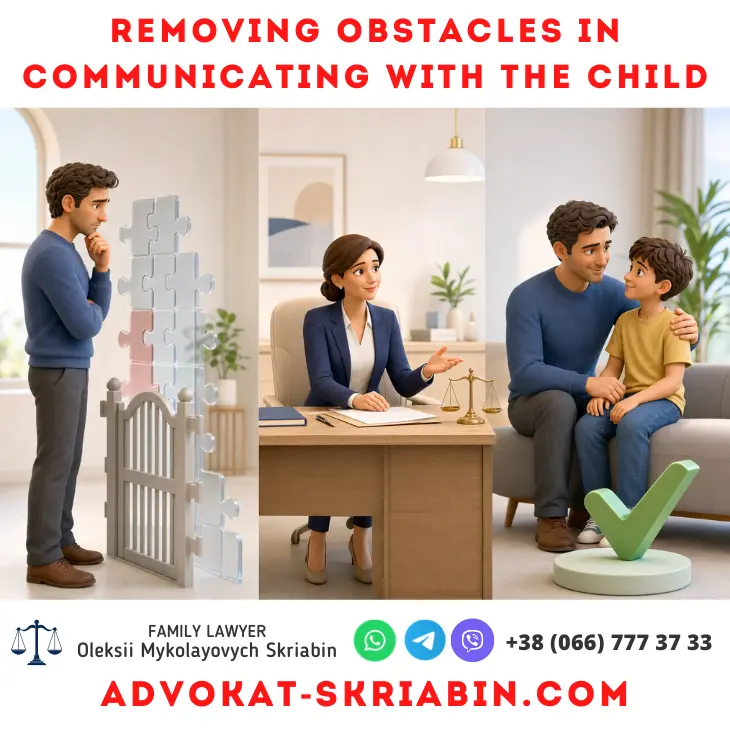

What Does Removing Obstacles in Communicating with a Child Mean
Removing obstacles in communicating with a child means restoring the real possibility for a mother or father to maintain contact with the child, participate in upbringing, receive information about the child, and spend time together when the parents live separately.
In practice, this legal issue usually appears after divorce, separation, relocation, conflict between parents, or when one parent believes that only they should decide how the child communicates with the other parent. Ukrainian family law is based on a different approach: the child has the right to maintain a relationship with both parents, unless such contact is legally limited for serious reasons.
Obstacles may include refusal to allow meetings, ignoring calls, blocking video communication, changing the child’s place of residence without informing the other parent, preventing school or medical involvement, or failing to follow an agreed child visitation schedule. The main purpose of legal protection is not to punish the other parent first. The purpose is to create a stable, safe, and enforceable model of communication between parent and child.
When Is a Parent’s Right to Communicate with a Child Violated
A parent’s right to communicate with a child is violated when the other parent deliberately makes contact impossible or unreasonably difficult. This can happen even when there is no formal court decision yet.
For example, the parent living with the child may say that meetings are “not convenient,” constantly cancel visits, refuse to answer messages, or allow communication only when it depends entirely on their mood. If this continues, it becomes not just a personal conflict but a legal problem.
The right to communicate with a child also includes participation in a child’s upbringing. This means the parent may be involved in education, health, development, emotional support, holidays, leisure, and important decisions affecting the child’s life.
A violation should be assessed through evidence, not emotions. Courts and guardianship authorities pay attention to repeated behavior, the child’s interests, the parents’ conduct, and whether the proposed communication schedule is realistic.
Can a Mother or Father Legally Prevent Contact with a Child
A mother or father cannot simply prevent contact with a child because of personal resentment, divorce conflict, unpaid emotional debts, or disagreement with the former spouse. Parental rights after divorce remain equal, and living separately from the child does not automatically reduce the rights of the other parent.
At the same time, contact may be limited if there are real risks for the child, such as violence, serious neglect, danger to health, manipulation, or other circumstances that harm the child’s interests. Such restrictions should not be invented as a pressure tool.
If one parent believes contact is unsafe, they should use legal mechanisms: apply to the guardianship and custody authority, collect evidence, or ask the court to define safe conditions of communication. Self-imposed bans without legal grounds often create additional conflict and may later be evaluated negatively. The key legal question is always the same: what communication model protects the child’s best interests while preserving the child’s relationship with both parents?
Rights of Parents to Participate in a Child’s Upbringing After Divorce
Parental rights after divorce do not disappear. Both parents remain responsible for the child’s upbringing, development, education, health, and emotional well-being. Divorce ends the marriage, not the parent-child relationship.
The parent living separately from the child may ask for regular meetings, video calls, holiday time, school involvement, access to information about the child, and participation in important decisions. This is part of normal communication between parent and child.
The parent with whom the child lives has a duty not to abuse their practical control over the child’s daily routine. They may organize the child’s life, but they should not isolate the child from the other parent without a valid legal reason.
A balanced approach is especially important when the child is under stress because of divorce, relocation, martial law, or living abroad. A predictable schedule can reduce conflict and give the child emotional stability.
How to Establish a Communication and Visitation Schedule with a Child
A child visitation schedule should be specific, practical, and suitable for the child’s age, school routine, health, distance between parents, and emotional condition. General phrases such as “when convenient” often do not work because they leave too much room for conflict.
A good schedule may define weekdays, weekends, holidays, birthdays, vacations, video calls, the place of transfer, who brings the child, and how missed meetings are rescheduled. The more precise the schedule, the easier it is to follow and enforce.
Parents may agree on the schedule voluntarily. If they cannot agree, the matter may be reviewed by the guardianship and custody authority or by a court. In more complex cases, the schedule should also consider living abroad, military service, safety restrictions, or long-distance communication. The schedule must serve the child, not the ego of either parent. Courts usually prefer realistic arrangements that can actually be performed.
Determining the Method of Participation in a Child’s Upbringing
Determining the method of participation in a child’s upbringing means legally defining how the parent who lives separately will take part in the child’s life. This is broader than physical visits. Participation may include meetings, overnight stays, joint holidays, video calls, school communication, medical information, extracurricular activities, and participation in important decisions. In some cases, gradual contact may be appropriate if the child has not seen the parent for a long time.
The court may define the time, place, frequency, and format of communication. It may also consider whether meetings should happen in the presence of another person at the beginning, especially if the relationship needs to be restored carefully. A well-prepared legal position should explain not only what the parent wants, but why this model is safe, stable, and beneficial for the child.
What to Do If You Are Not Allowed to See Your Child
If you are not allowed to see your child, avoid impulsive actions, threats, public conflict, or pressure on the child. These actions can harm both the child and your future legal position. Start by fixing the facts. Save messages, call history, proof of attempted visits, travel confirmations, school correspondence, medical communication, and any written refusals. Evidence should show a pattern of obstacles in communication with a child.
Then propose a written communication schedule. It should be calm, specific, and child-focused. If the other parent ignores it or refuses without valid reasons, you can apply to the guardianship and custody authority or prepare a lawsuit for communication with a child. A family lawyer in child custody disputes can help formulate the claims correctly, collect evidence, and avoid mistakes that delay the case.
Resolving Disputes Through the Guardianship and Custody Authority
The guardianship and custody authority may review disputes between parents regarding participation in a child’s upbringing. This stage can be useful when the conflict may still be resolved without court or when the future court case needs additional official assessment.
The authority may communicate with parents, evaluate living conditions, consider the child’s situation, and provide conclusions or decisions depending on the legal context. Its role is focused on the child’s interests, not on supporting one parent against the other.
However, if the other parent ignores the authority’s decision or continues preventing communication, court proceedings may become necessary. In such cases, the previous application may help demonstrate that the parent tried to resolve the issue legally and peacefully.
This stage should be prepared carefully. Emotional accusations are less effective than clear facts, proposed solutions, and evidence of the child’s need for stable contact. When parents cannot agree, the guardianship authority may help define communication rules before the dispute moves to court.
Filing a Lawsuit to Remove Obstacles in Communicating with a Child
A lawsuit to remove obstacles in communicating with a child is filed when the parent living separately cannot exercise their right to communicate and participate in upbringing because the other parent prevents it.
In the lawsuit, it is important to ask not only to “remove obstacles,” but also to determine a concrete method of participation in the child’s upbringing. The court should understand exactly what schedule the parent asks to establish.
The claim may include regular meetings, weekend communication, holidays, vacation time, video calls, remote contact, and rules for transferring the child. If the parent lives abroad, the claim should explain how communication can be organized across distance. A lawyer may represent the client’s interests on the basis of a legal services agreement, which can be concluded online. No power of attorney is required for this.
Documents Required for Court Proceedings Regarding Child Contact
For court proceedings regarding child contact, the documents should confirm the family relationship, the existence of obstacles, the proposed communication model, and the circumstances relevant to the child’s interests.
Usually, the case may require documents confirming parenthood, divorce or separation circumstances, the child’s residence, correspondence between parents, proof of attempts to communicate, school or medical information, and evidence showing the parent’s involvement in the child’s life.
If the parent lives abroad, additional documents may be needed to confirm residence, employment, travel possibilities, communication conditions, or the ability to maintain regular online contact. Foreign documents may require translation into Ukrainian.
The quality of documents often matters more than the number of pages. The court needs a clear picture: what happened, how the child is affected, what the parent asks for, and why the requested schedule is reasonable. In family disputes, an attorney request in family cases may help obtain information that supports the legal position.
Court Practice on Communication Between a Parent and a Child
Court practice on communication between parent and child is based on the child’s best interests, equality of parents, and the need for stable upbringing. Courts usually do not support artificial isolation of a child from one parent without serious grounds.
At the same time, courts do not automatically approve every schedule requested by a parent. The court evaluates the child’s age, health, routine, emotional connection, distance, safety, previous participation in upbringing, and the behavior of both parents.
If the conflict is intense, the court may choose a gradual model of communication. For example, contact may begin with shorter meetings or online communication and later expand if it is safe and beneficial for the child.
A persuasive legal position should show that the parent is not trying to continue conflict through the child but genuinely wants a stable relationship and responsible participation in upbringing. For legal context, courts apply the principles of Ukrainian family law, including the equality of parental rights and the child’s best interests.
Enforcement of a Court Decision on Child Visitation
A court decision on child visitation must be performed. If one parent continues to prevent communication after the decision becomes enforceable, enforcement mechanisms may be used under Ukrainian law.
The enforcement stage can be emotionally difficult because the child may be placed in the middle of the conflict. That is why the court decision should be as specific as possible: dates, time, place, format, and transfer procedure should be clear.
If the decision is vague, enforcement becomes harder. If it is precise, the parent can better prove non-compliance and ask for legal reaction. The parent seeking enforcement should remain calm, document each violation, and avoid actions that could be presented as pressure on the child.
Liability for Preventing Communication with a Child
Preventing communication with a child may lead to legal consequences, especially when there is a court decision or an official schedule that one parent refuses to follow. Liability depends on the circumstances. It may include enforcement measures, procedural consequences in future disputes, and negative evaluation of the parent’s behavior by the court. The main issue is whether the parent is acting in the child’s interests or using the child as an instrument of pressure.
A parent who repeatedly blocks contact should understand that the court may consider such conduct when resolving future disputes about upbringing, residence, or communication. The safest approach is to follow the established schedule or legally request changes if circumstances have truly changed. If the dispute concerns obstruction in communication with the child, each refusal or violation should be documented carefully.
Communication with a Child During Martial Law and Living Separately
During martial law, communication with a child may become more complicated because of relocation, safety risks, military service, damaged infrastructure, border issues, or residence abroad. These circumstances should be considered, but they do not automatically cancel parental rights.
If physical meetings are temporarily difficult, remote communication may become especially important. Video calls, voice messages, online meetings, shared educational activities, and scheduled communication can help preserve the emotional bond.
When one parent and the child live abroad, the legal strategy may require additional analysis of jurisdiction, documents, and possible recognition or enforcement issues. Still, Ukrainian citizens often need a Ukrainian legal solution when the family relationship, divorce, or previous residence is connected with Ukraine.
The online divorce service can help coordinate legal steps remotely when the parent cannot personally attend offices or court-related procedures in Ukraine. If the dispute also involves relocation, border crossing, or travel restrictions, the issue of a child’s departure abroad without father’s consent may require separate legal analysis.
How a Family Lawyer Can Help Protect Your Parental Rights
A family lawyer can help assess whether the situation is a legal obstacle, prepare evidence, formulate a realistic child visitation schedule, communicate with the guardianship and custody authority, and file a lawsuit if needed.
Legal assistance is especially important when the other parent manipulates facts, the child lives in another city or country, there is martial law-related relocation, or the parent needs remote representation in Ukraine.
A lawyer also helps avoid common mistakes: emotional claims, vague schedules, weak evidence, missing documents, or requests that are difficult to enforce. The goal is to create a legal position that protects both parental rights and the child’s emotional stability.
If you need support, you may request a consultation, describe your situation, and receive a clear plan of action. In many family disputes, online participation of a lawyer in family cases helps clients act remotely without losing procedural control.
Step-by-Step Guide
- Define the exact obstacle: refusal of meetings, blocked calls, ignored messages, hidden information, relocation, or failure to follow an agreed schedule.
- Collect evidence calmly: correspondence, call logs, travel confirmations, written refusals, school or medical messages, and proof of your participation in the child’s life.
- Propose a written child visitation schedule with clear days, times, video calls, holidays, transfer rules, and rescheduling procedure.
- Apply to the guardianship and custody authority if the dispute may be resolved administratively or if an official assessment is needed.
- Prepare a lawsuit for communication with a child if the obstacles continue or the other parent ignores reasonable proposals.
- Ask the court to determine a specific method of participation in the child’s upbringing, not only to remove obstacles in general.
- Enforce the court decision if the other parent continues preventing communication after the decision becomes binding.
Useful materials on the site advokat-skriabin.com
- Apostille (legalization) of educational documents
- Apostille (legalization) of a court decision on divorce
- Obtain a court decision on divorce
- Obtain a court decision on alimony
- Obtain a writ of execution for alimony
- Prohibition on a child’s travel abroad
- Establishing the fact of birth in the occupied territory
- Establishing the fact of death in the occupied territory
- Establishing paternity
- Establishing the fact of living together as one family without registering a marriage