
- What Is Deprivation of Parental Rights in Ukraine
- Grounds for Deprivation of Parental Rights Under Ukrainian Law
- Who Can File a Claim for Deprivation of Parental Rights
- How to Deprive a Father of Parental Rights Through Court
- How to Deprive a Mother of Parental Rights in Ukraine
- Required Documents for Deprivation of Parental Rights
- The Court Procedure for Deprivation of Parental Rights
- Can Parental Rights Be Terminated for Non-Payment of Child Support
- Deprivation of Parental Rights When a Parent Lives Abroad
- The Role of the Guardianship and Custody Authority in Court Cases
- Legal Consequences of Deprivation of Parental Rights
- Child Support Obligations After Deprivation of Parental Rights
- Can Parental Rights Be Restored After Deprivation
- Online Legal Assistance for Deprivation of Parental Rights Cases
- Family Lawyer Services in Deprivation of Parental Rights Proceedings
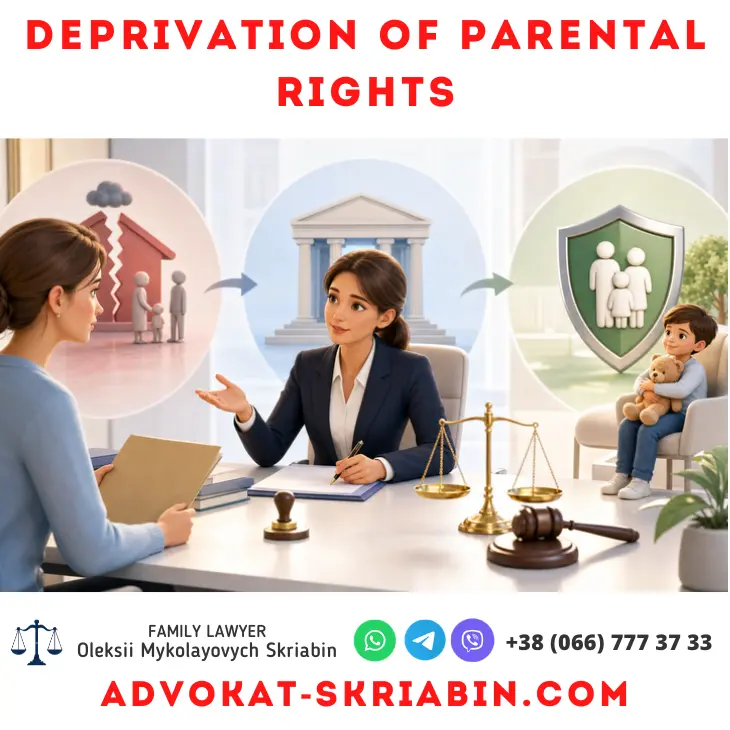

What Is Deprivation of Parental Rights in Ukraine
Deprivation of parental rights in Ukraine is a court procedure through which a mother or father loses personal non-property parental rights in relation to a child. This means that the parent no longer has the legal authority to raise the child, represent the child, decide important issues of upbringing, or rely on parental status in future legal relations.
At the same time, deprivation of parental rights does not cancel the biological connection between the parent and the child. It also does not automatically release the parent from financial duties. In most cases, child support obligations remain, because the child must not suffer financially due to the parent’s unlawful behavior or failure to act responsibly.
A court does not deprive a parent of rights simply because the other parent is upset, offended, or dissatisfied with communication. The judge examines evidence, the child’s interests, the behavior of both parents, the opinion of the guardianship and custody authority, and the real impact of the parent’s conduct on the child.
Grounds for Deprivation of Parental Rights Under Ukrainian Law
The grounds for deprivation of parental rights are connected with serious failure to perform parental duties or behavior that is harmful to the child. Ukrainian family law treats such cases carefully because the court decision changes the legal status of the parent and directly affects the child’s future.
Typical grounds may include persistent avoidance of upbringing, failure to care for the child, cruelty, harmful behavior, exploitation of the child, chronic neglect, or other circumstances showing that the parent is not acting in the child’s interests. Non-payment of child support may also be relevant, especially when it is combined with total absence from the child’s life and avoidance of parental responsibility.
The court evaluates not only the fact of misconduct, but also its duration, seriousness, consequences, and proof. A single argument between parents or temporary financial difficulty is usually not enough. A claim for deprivation of parental rights must show a stable pattern of behavior that contradicts the child’s welfare.
Who Can File a Claim for Deprivation of Parental Rights
A claim for deprivation of parental rights may be filed by persons or institutions authorized by law to protect the child. In practice, such claims are often filed by the other parent, a guardian, a person with whom the child lives, a guardianship and custody authority, or another legally authorized body.
The claimant must explain why court intervention is necessary and why a less severe measure would not protect the child properly. The court will not rely only on emotions or general accusations. It needs documents, witness statements, official records, evidence of non-participation in upbringing, child support debt, or other materials proving the parent’s conduct.
For Ukrainians living abroad, the claim may still be prepared and filed in Ukraine if the case falls under Ukrainian jurisdiction. Legal assistance can often be arranged remotely, especially when documents are exchanged electronically and the lawyer provides remote representation in family proceedings in court.
How to Deprive a Father of Parental Rights Through Court
Deprivation of a father’s parental rights is usually considered when the father does not participate in the child’s life, avoids upbringing, does not communicate with the child, ignores child support obligations, or creates circumstances that harm the child. However, each case must be proven individually.
The mother or another authorized person should collect evidence before filing the claim. This may include documents confirming child support debt, messages showing refusal to participate in the child’s life, school or medical records, statements from witnesses, and materials from the guardianship authority.
The court will also consider whether the father had a real opportunity to participate in the child’s life. If he was prevented from seeing the child, the case may become more complex. That is why the claim should focus not on personal conflict, but on the child’s interests and documented parental neglect.
How to Deprive a Mother of Parental Rights in Ukraine
Deprivation of a mother’s parental rights in Ukraine follows the same legal logic as deprivation of a father’s rights. Ukrainian law does not create an automatic preference for one parent when the issue concerns serious failure to perform parental duties.
A court may consider such a case when the mother avoids raising the child, leaves the child without care, behaves in a way that endangers the child, or does not fulfill basic parental responsibilities. The key question is whether her conduct is harmful to the child and whether deprivation is necessary to protect the child.
The father, guardian, or another authorized person must provide evidence. The court will assess the child’s living conditions, emotional safety, actual care, communication with the parent, and the conclusion of the guardianship and custody authority.
Required Documents for Deprivation of Parental Rights
The required documents for deprivation of parental rights depend on the facts of the case. There is no universal package that fits every family situation, because the court evaluates individual circumstances.
Usually, the claimant prepares documents confirming the child’s birth, the parent-child relationship, the child’s residence, the behavior of the parent, child support debt if applicable, and evidence showing non-participation in upbringing. The statement of claim must be legally structured and supported by relevant proof.
A practical document package may include:
- Child’s birth certificate and documents confirming the parties’ identity.
- Evidence of the child’s residence and actual care.
- Proof of non-payment of child support or enforcement materials.
- School, medical, psychological, or social service records.
- Witness statements, correspondence, or other evidence of parental neglect.
- Materials connected with the guardianship and custody authority.
- A properly prepared claim for deprivation of parental rights.
The stronger and more consistent the evidence is, the better the court can understand why deprivation is necessary. In some cases, a lawyer may use a formal attorney request to obtain evidence in family disputes when important documents or information are difficult for the client to collect independently.
The Court Procedure for Deprivation of Parental Rights
The court procedure for deprivation of parental rights begins with preparation of the claim and evidence. The claim is filed with the competent court, after which the court opens proceedings, requests necessary materials, involves the guardianship and custody authority, and schedules hearings.
The guardianship and custody authority usually plays an important role because it examines the child’s circumstances and provides a conclusion for the court. The judge is not automatically bound by this conclusion, but it often has significant practical value.
During the hearings, the court studies written evidence, listens to the parties, may question witnesses, and assesses whether deprivation of parental rights is proportionate and necessary. The child’s interests are the central factor in the case.
Can Parental Rights Be Terminated for Non-Payment of Child Support
Deprivation of parental rights for non-payment of child support is possible only when non-payment shows a broader failure to perform parental duties. Debt alone may not always be enough if the parent still participates in the child’s life, communicates responsibly, and has objective reasons for financial difficulties.
However, if the parent systematically avoids child support, ignores enforcement proceedings, does not communicate with the child, does not help with education or medical needs, and shows no real parental involvement, this may support a claim for deprivation of parental rights.
The court will evaluate the full situation. For example, it may consider enforcement documents, the amount and duration of debt, the parent’s conduct, attempts to hide income, and the absence of care or communication, including facts connected with legal liability for unpaid child support.
Deprivation of Parental Rights When a Parent Lives Abroad
Deprivation of parental rights when a parent lives abroad is a common issue for Ukrainian families. A parent may move to another country and stop participating in the child’s life, ignore communication, avoid child support, or refuse to resolve important legal questions concerning the child.
Residence abroad does not automatically justify deprivation of parental rights. Many parents live outside Ukraine but continue supporting and raising their children responsibly. The key issue is not the location, but the parent’s behavior and the effect on the child.
If the parent abroad avoids duties, the claimant should collect evidence of non-participation, lack of support, refusal to communicate, or other facts relevant to the child’s interests. Documents from abroad may need translation into Ukrainian for court use.
The Role of the Guardianship and Custody Authority in Court Cases
The guardianship and custody authority helps the court assess the child’s interests. It may inspect living conditions, communicate with the parties, analyze the child’s situation, and prepare a written conclusion for the court.
This authority does not replace the court. The final decision belongs to the judge. However, its conclusion can influence how the court understands the child’s daily life, emotional environment, and safety.
In complex cases, cooperation with the guardianship authority should be careful and well prepared. The claimant should provide accurate information, documents, and explanations that show why deprivation of parental rights is necessary for the child’s protection, especially if there are long-term barriers to communication with the child.
Legal Consequences of Deprivation of Parental Rights
Legal consequences of deprivation of parental rights are serious. The deprived parent loses personal parental rights, cannot legally represent the child, cannot make decisions on upbringing, and may lose future rights connected with parental status.
The parent also loses certain benefits and legal opportunities based on being a parent. For example, such a person may not rely on parental status for future support from the child or other rights that depend on proper parental conduct.
Important: deprivation of parental rights does not erase the child’s rights. The child may still have property, inheritance, and support-related rights where applicable. The law protects the child, not the parent who failed to perform duties.
Child Support Obligations After Deprivation of Parental Rights
Child support obligations after deprivation of parental rights usually remain. This is a key point that many parents misunderstand. A parent cannot avoid financial responsibility simply because parental rights have been terminated by court.
The logic is simple: deprivation affects parental rights, but it does not cancel the child’s need for financial support. The child still needs housing, food, education, medical care, clothing, and stable development.
If child support has not yet been ordered, the issue may be raised separately or together with related family law claims where procedurally appropriate. If there is already a court decision on child support, enforcement may continue after deprivation of parental rights, including through legal collection of financial support for a child.
Can Parental Rights Be Restored After Deprivation
Restoration of parental rights is possible only through court and only if the parent proves that circumstances have changed. The court must be convinced that restoration is consistent with the child’s interests and that the parent is now able to act responsibly.
A parent who wants restoration of parental rights should show real changes, not only promises. This may include stable behavior, participation in the child’s life where appropriate, fulfillment of financial duties, safe living conditions, and a responsible attitude toward upbringing. The child’s interests remain decisive. If restoration may harm the child or destabilize the child’s life, the court may refuse it.
Online Legal Assistance for Deprivation of Parental Rights Cases
Online legal assistance for deprivation of parental rights cases is especially useful when the client lives abroad, cannot attend court personally, or needs fast preparation of documents. Many stages can be organized remotely: consultation, document review, strategy, drafting of the claim, and communication with the lawyer.
A lawyer can analyze whether there are sufficient grounds for deprivation of parental rights, what evidence is missing, which court should consider the case, and what procedural risks may arise. This helps avoid weak claims and unnecessary delays. The Online Divorce Service may provide remote legal support in related family law matters, including parental rights, child support, and representation in Ukrainian courts.
Family Lawyer Services in Deprivation of Parental Rights Proceedings
A family lawyer for parental rights cases helps build the legal position, prepare the claim, organize evidence, communicate with the guardianship authority, and represent the client in court. This is important because deprivation of parental rights is not a formal procedure; it is a serious dispute that requires proof.
The lawyer also helps the client separate emotional conflict from legally relevant facts. Courts need evidence, not general dissatisfaction with the other parent. A professional legal position should show how the parent’s conduct affects the child and why court protection is necessary. A lawyer represents the interests of a client on the basis of a legal assistance agreement, which can be concluded online. A power of attorney is not required for this.рібна.
Step-by-Step Guide
- Assess whether there are real legal grounds for deprivation of parental rights. The case should be based on the child’s interests, not only on conflict between adults.
- Collect evidence. Documents, messages, enforcement materials, witness information, and records from schools or medical institutions may be important.
- Prepare a legally structured claim for deprivation of parental rights. The claim must explain the facts, evidence, legal grounds, and requested court decision.
- Involve the guardianship and custody authority. Its conclusion may become an important part of the case.
- Participate in court proceedings or authorize a lawyer to represent your interests. Remote cooperation is often possible.
- After the court decision, analyze whether additional actions are needed, such as child support enforcement, document updates, protection of the child’s rights, or future issues connected with adoption after changes in parental status.
Useful materials on the site advokat-skriabin.com
- Legalization of documents for France
- Legalization of documents for Portugal
- Legalization of documents for Georgia
- Legalization of documents for Italy
- Legalization of documents for Spain
- Legalization of documents for the Czech Republic
- Legalization of documents for Poland
- Legalization of documents for Germany
- Legal assistance in divorce for the defendant
- Obtain a birth certificate