
- What does establishing the fact of independent upbringing of a child mean
- When is it necessary to confirm independent upbringing of a child
- Establishing the fact of independent upbringing of a child through court
- Who can apply to establish the fact of independent upbringing of a child
- Independent upbringing of a child by the father: legal features
- Independent upbringing of a child by the mother: what must be proven
- Documents for establishing the fact of independent upbringing of a child
- What evidence confirms independent upbringing and child support
- Is divorce enough to prove independent upbringing of a child
- Court practice on establishing the fact of independent upbringing of a child
- Independent upbringing of a child for military deferment and official authorities
- How to file an application to court for independent upbringing of a child
- When can the court refuse to establish the fact of independent upbringing
- Online legal assistance in cases of independent upbringing of a child
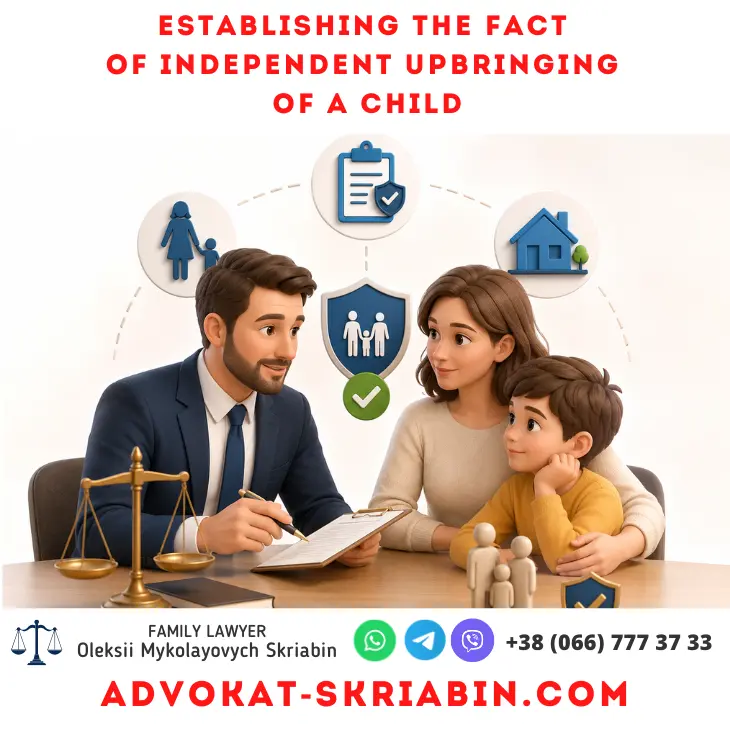

What does establishing the fact of independent upbringing of a child mean
Establishing the fact of independent upbringing of a child means confirming, through a legal procedure, that one parent actually takes care of the child without real participation of the other parent. It is not only about living in the same apartment with the child. The court usually looks at who provides daily care, who makes decisions about education and health, who pays for the child’s needs, and whether the other parent is truly absent from the upbringing process.
In practice, establishing the fact of independent upbringing of a child is required when an official authority needs not just words, but a legally reliable confirmation. A parent may say that he or she raises the child alone, but an authority may request documents, evidence, or a court decision. In many cases, such a request is close to the broader category of establishing legal facts in Ukraine, where the court confirms circumstances that have legal importance.
Independent upbringing of a child in Ukraine is a factual situation that must be proven carefully. The court does not automatically recognize independent upbringing only because the parents are divorced, live separately, or have a conflict. The applicant must show a stable pattern: the child is cared for by one parent, the other parent does not perform parental duties in a real and consistent way, and the requested fact has legal importance.
When is it necessary to confirm independent upbringing of a child
Confirmation may be necessary when a parent applies to state authorities, social institutions, educational institutions, consular bodies, military authorities, or other official structures. In many cases, a simple explanation is not enough because the authority must rely on written documents. That is why establishing independent upbringing of a child through court may become the safest way to remove legal uncertainty.
This issue often arises when the parent needs to prove that he or she is the only person who actually cares for the child. For example, the parent may need to solve questions related to residence, documents, travel, social benefits, education, medical decisions, military deferment, or protection of the child’s interests. The exact purpose must be clearly explained in the application because the court must understand why the fact is legally significant.
A common mistake is to wait until the authority refuses to accept informal explanations. It is better to analyze the situation in advance: what document is requested, what fact must be confirmed, and whether there is enough evidence. If the case concerns divorce, children, residence abroad, or communication with Ukrainian authorities from another country, the parent may need remote legal preparation and carefully structured evidence, including issues related to online participation of a lawyer in family cases.
Establishing the fact of independent upbringing of a child through court
Establishing the fact of independent upbringing of a child through court is usually used when there is no other effective administrative way to confirm the required fact. The court examines whether the applicant really has a legal interest and whether the fact cannot be properly confirmed by another available document. This is why the application must not be written as a general life story; it must be legally focused.
The court procedure requires a clear explanation of the circumstances. The applicant should describe where the child lives, who provides care, whether the other parent communicates with the child, whether financial support is provided, who deals with school, healthcare, everyday expenses, and official issues. The more structured the application is, the easier it is for the court to understand the legal meaning of the case.
It is also important to separate this procedure from disputes about parental rights, deprivation of parental rights, child residence, alimony, or visitation. Establishing a legal fact is not the same as punishing the other parent. The purpose is to confirm a factual situation that already exists and that has legal consequences for the applicant or the child.
Who can apply to establish the fact of independent upbringing of a child
Usually, the applicant is the parent who actually raises the child and needs official confirmation of this fact. It can be the father or the mother, depending on the real family situation. The decisive factor is not gender, but evidence: who lives with the child, who supports the child, who is involved in daily care, and who is responsible for important decisions.
A parent living abroad may also need such confirmation if the child remains in Ukraine or if the parent and child are outside Ukraine but still need Ukrainian legal documents. In such situations, documents from foreign authorities may require translation, certification, and careful explanation for a Ukrainian court or authority. The court will evaluate whether the evidence confirms the relevant circumstances according to Ukrainian procedural standards.
The application for establishing independent upbringing of a child should clearly state why this parent applies and what legal result is expected. If the purpose is vague, the court may have questions. Therefore, the applicant should connect the fact of independent upbringing with a specific legal need: an authority request, a pending procedure, a need to obtain status, a need to protect the child’s interests, or another official purpose.
Independent upbringing of a child by the father: legal features
Independent upbringing of a child by father often requires especially careful evidence because some authorities still informally assume that the mother is the main caregiver. Ukrainian family law is based on equality of parental rights and duties, so the father has the right to prove that he is the parent who actually raises the child independently. The court should evaluate the real situation, not stereotypes.
The father may need to prove that the child lives with him, that he pays for everyday needs, communicates with school or kindergarten, arranges medical care, and deals with official issues. If the mother is absent, lives separately, avoids participation, does not support the child, or has limited real contact, these circumstances must be confirmed by documents and witness explanations where appropriate.
The key point is that independent upbringing of a child by father is not proven only by emotional statements. The court needs a consistent picture supported by evidence. Bank records, school confirmations, medical documents, residence documents, correspondence, local authority information, and other materials may help show that the father is the parent who performs parental duties in practice.
Independent upbringing of a child by the mother: what must be proven
Independent upbringing of a child by mother may seem obvious in many family situations, but legally it still requires proof. If the father is recorded in the birth certificate, the court or authority may ask whether he participates in the child’s upbringing, provides support, communicates with the child, or is involved in decisions. The mother must show not only that she lives with the child, but also that she independently carries the real burden of care.
The evidence should demonstrate daily responsibility. This may include documents showing the child’s place of residence, school or kindergarten information, medical records, proof of expenses, evidence of communication with the other parent, and other materials. If the case also involves where the child should live permanently, the issue may be connected with determining the child’s place of residence, which is a separate family-law procedure.
A typical problem arises when the father does not help in reality but formally remains a parent in documents. In such cases, authorities may not accept the mother’s oral explanation. Establishing the fact of independent upbringing of a child through court can create a stronger legal basis for further communication with official institutions.
Documents for establishing the fact of independent upbringing of a child
Documents for independent upbringing of a child should be selected according to the purpose of the case. The same document package is not suitable for every situation. A case connected with military deferment may require one type of explanation, while a case connected with social protection, residence, or consular issues may require another. The legal strategy should begin with identifying the authority that needs confirmation.
The basic document package usually includes documents confirming the child’s identity and family connection, documents confirming residence, materials showing actual care and support, and evidence explaining the role or absence of the other parent. If the applicant lives abroad or some documents were issued outside Ukraine, translation and proper certification may be needed before they can be used in Ukraine.
Step-by-step instruction
- Define the legal purpose of the case. Before preparing an application for establishing independent upbringing of a child, determine why the fact must be confirmed and which authority will use the court decision.
- Collect personal and family documents. Prepare the child’s birth certificate, documents confirming the applicant’s identity, documents about marriage or divorce if relevant, and materials showing the family situation.
- Prepare evidence of daily care. Gather school, kindergarten, medical, residence, financial, and communication evidence that shows who actually raises and supports the child.
- Analyze the role of the other parent. The court needs to understand whether the other parent participates in upbringing, provides support, communicates with the child, or is absent from real parental duties.
- Draft the application to court. The application should be legally structured, explain the purpose of establishing the fact, describe the evidence, and avoid emotional or unsupported accusations.
- Submit the case and participate in the procedure. The applicant or a lawyer may communicate with the court, submit documents, provide explanations, and respond to court requests.
- Use the court decision for the intended purpose. After the decision enters into legal force, it can be provided to the relevant authority as confirmation of the established fact.
What evidence confirms independent upbringing and child support
Evidence of independent upbringing of a child must show a stable and real situation. The court usually evaluates all materials together rather than relying on one document. A certificate of residence may show where the child lives, but it does not always prove who pays expenses, who attends school meetings, who takes the child to doctors, or who makes everyday decisions.
Useful evidence may include school or kindergarten confirmations, medical documents, proof of payment for the child’s needs, bank transfers, correspondence with the other parent, documents from local authorities, evidence of residence, statements from persons who know the family situation, and materials showing lack of real participation by the other parent. The evidence should be logical, consistent, and connected to the legal purpose of the case.
Child support evidence is also important, but it must be interpreted correctly. If the other parent pays alimony, this does not automatically mean that independent upbringing is impossible. Financial support and actual upbringing are different categories. At the same time, if the other parent does not provide money and does not participate in care, this can strengthen the applicant’s position, especially when the situation is related to alimony after divorce.
Is divorce enough to prove independent upbringing of a child
Divorce is not enough by itself to prove independent upbringing of a child. After divorce, both parents usually continue to have parental rights and duties. The fact that the marriage ended does not automatically mean that one parent disappeared from the child’s life or stopped participating in upbringing.
This is one of the most common mistakes in such cases. A parent may believe that a divorce certificate or court decision on divorce automatically confirms independent care. In reality, the court will look at what happened after separation: where the child lives, who provides care, whether the other parent communicates with the child, whether support is paid, and whether parental duties are performed.
If the situation arose after divorce or is connected with divorce proceedings, it is important to coordinate the evidence carefully. The online divorce service may be useful when the family-law situation includes divorce, children, court documents, and remote communication with Ukrainian authorities, especially when one of the parents is abroad.
Court practice on establishing the fact of independent upbringing of a child
Court practice in these cases is evidence-based. Courts usually do not accept abstract statements such as “I raise the child alone” without documents and clear explanations. The applicant should show why the case is not a general family conflict but a legally significant fact that must be confirmed for a specific purpose.
The court may pay attention to whether there is a dispute between the parents. If the case actually hides a conflict about residence, visitation, alimony, or parental rights, the court may consider that another legal procedure is more appropriate. Therefore, the application must be drafted carefully so that the court understands the correct procedural nature of the request.
A strong case usually contains a clear legal purpose, consistent documents, and a realistic description of family circumstances. A weak case often contains emotional accusations, missing evidence, unclear purpose, or attempts to replace another legal procedure with establishing a fact. To understand the legal framework, it is also useful to rely on the Family Code of Ukraine and procedural legislation, where official Ukrainian legal texts are published.
Independent upbringing of a child for military deferment and official authorities
Independent upbringing of a child for military deferment is one of the situations where official confirmation may become especially important. Authorities usually need documents that clearly show the legal basis for the request. If the parent only explains the situation orally, this may not be enough, especially when the other parent is formally recorded in documents.
In such cases, the evidence must be connected not only with the child’s residence but also with the actual absence or non-participation of the other parent in upbringing. The applicant should be ready to show who performs parental duties, who supports the child, and why the child depends on this parent’s daily care. A court decision can help when other documents do not fully reflect the real family situation.
At the same time, each military, administrative, or social procedure has its own document requirements. Establishing the fact of independent upbringing of a child does not replace all other documents that an authority may request. It strengthens the legal position, but the full package should be prepared according to the specific purpose.
How to file an application to court for independent upbringing of a child
The application for establishing independent upbringing of a child must be filed with the competent court according to procedural rules. The text should include the applicant’s details, information about the child, circumstances of independent upbringing, explanation of the other parent’s role, legal purpose of the application, and a list of evidence. The request should be precise and understandable.
The court should see that the applicant is not asking for an abstract declaration. The application must explain why the fact has legal importance and why it cannot be confirmed in another way. If the applicant has received a request from an authority or faced a practical need to submit confirmation, this should be described and supported by documents if possible.
A lawyer can prepare the application, organize evidence, communicate with the court, and represent the applicant’s interests. A lawyer represents the client’s interests on the basis of a legal assistance agreement, which can be concluded online. No power of attorney is required for this. This is especially convenient when the applicant lives abroad, cannot attend court personally, or needs remote preparation of documents.
When can the court refuse to establish the fact of independent upbringing
The court may refuse if the applicant does not prove the legal significance of the fact. If the application does not explain why the confirmation is needed, the court may consider the request unfounded. The fact must be connected with real legal consequences, not only with a desire to receive a general confirmation.
Another reason for refusal may be insufficient evidence. If the applicant only submits a birth certificate and divorce document, this may not be enough. The court needs materials that show actual independent care, support, residence, and the real role of the other parent. Contradictory or incomplete evidence can weaken the case.
The court may also refuse or leave the issue for another procedure if there is a real dispute about parental rights, child residence, visitation, alimony, or deprivation of parental rights. Establishing a fact is not designed to replace a full dispute between parents. That is why family lawyer consultation before filing is very important.
Online legal assistance in cases of independent upbringing of a child
Online legal assistance is useful when the parent needs to prepare documents without visiting a lawyer’s office or when the applicant is outside Ukraine. The lawyer can analyze the situation, determine whether court confirmation is needed, prepare the application, structure the evidence, and explain how to use the court decision before the relevant authority.
Remote work is especially helpful when documents are located in different countries, when translations are required, or when the parent cannot personally attend court because of work, residence abroad, childcare, or other circumstances. The main task is to make the case clear, evidence-based, and procedurally correct from the beginning.
If the matter is connected with divorce, children, residence abroad, court documents, or communication with Ukrainian authorities, you may contact the online divorce service for legal assistance. A family lawyer can assess whether establishing the fact of independent upbringing of a child is the right procedure, what evidence should be prepared, and how to organize the case remotely.
Phone / Viber / WhatsApp / Telegram: +380667773733
Email: skriabinadvokat@gmail.com