- Can You Divorce a Convicted Person in Ukraine
- How to Divorce a Spouse Serving a Prison Sentence
- When Is Court Divorce Required for a Convicted Person
- Can You Divorce Without the Convicted Spouse’s Consent
- Documents Required for Divorce with a Convicted Person
- How to File for Divorce If Your Husband or Wife Is in Prison
- Can You Apply for Divorce Online If Your Spouse Is Imprisoned
- How the Court Notifies an Imprisoned Spouse About Divorce Proceedings
- Divorce with a Convicted Person When Children Are Involved
- Property Division After Divorce with a Convicted Spouse
- Can You Claim Child Support from a Convicted Person
- How Long Does Divorce with a Convicted Person Take
- Legal Costs and Court Fees for Divorce
- How a Family Lawyer Can Help with Divorce from a Convicted Person
- Step-by-Step Instruction
Can You Divorce a Convicted Person in Ukraine
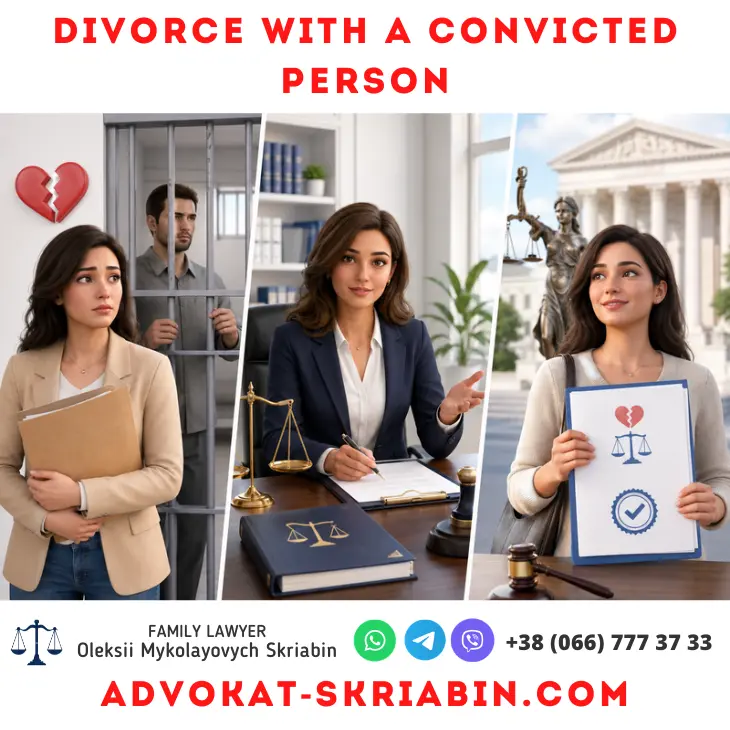
Yes, divorce with a convicted person is legally possible in Ukraine. A prison sentence does not block the right of the other spouse to end the marriage. Ukrainian family law is based on the principle that marriage must remain a voluntary union, so a person cannot be forced to stay married only because the other spouse is imprisoned.
In practice, divorce with a spouse in prison usually requires careful preparation because the convicted spouse may be located in a correctional facility, may not be able to attend hearings, may not respond to documents, or may try to delay the case. These circumstances do not automatically stop the court from considering the divorce claim.
The court examines whether the marriage has actually broken down and whether further family life is impossible or contrary to the interests of one of the spouses. If the applicant clearly explains the situation and provides proper documents, the court may dissolve the marriage even without active participation of the convicted spouse.
How to Divorce a Spouse Serving a Prison Sentence
To divorce a spouse serving a prison sentence, the applicant usually files a statement of claim with the competent court. The claim must explain the marriage history, the fact of conviction or imprisonment, the absence of normal family life, and the applicant’s request to dissolve the marriage.
The court process may take place without the applicant’s personal attendance if documents are prepared correctly and the applicant asks the court to consider the case in their absence. This is especially important for Ukrainians living abroad or people who cannot travel to court because of work, health, safety or family reasons.
A family lawyer for divorce can prepare the claim, organize the evidence, communicate with the court and help avoid procedural mistakes. A lawyer represents the client’s interests on the basis of a legal assistance agreement, which can be concluded online. A power of attorney is not required for this.
When Is Court Divorce Required for a Convicted Person
Court divorce is required when the marriage cannot be dissolved through the civil registry office, for example when the spouses have minor children, when one spouse does not consent, when joint filing is impossible, or when the convicted spouse cannot properly participate in an administrative divorce procedure.
A court procedure for ending a marriage in Ukraine is also the safest option when the applicant does not have reliable communication with the imprisoned spouse. The court has procedural tools to notify the defendant, request information, evaluate evidence and issue a divorce judgment, while general information about court access and judicial organization can be checked through the official Judiciary of Ukraine portal.
If there are children, property disputes or child support questions, these issues may require separate legal assessment. In many cases, divorce itself can be considered separately from property division or child support, which helps the applicant end the marriage faster and resolve financial matters later or in parallel.
Can You Divorce Without the Convicted Spouse’s Consent
Divorce without spouse’s consent is possible in Ukraine. Consent may simplify the process, but it is not always necessary. If one spouse wants to end the marriage and proves that the family relationship has ended, the court may dissolve the marriage even if the other spouse refuses, remains silent or is imprisoned.
The convicted spouse has the right to be informed about the proceedings and to submit objections. However, ending a marriage without the other spouse’s consent does not mean the defendant has the right to force the applicant to remain married. The court balances procedural rights with the applicant’s right to personal freedom and family life.
A common mistake is waiting for written consent from the imprisoned spouse when it is not realistically possible to obtain it. In many cases, the better approach is to prepare a clear court claim and let the court handle notification and procedural communication.
Documents Required for Divorce with a Convicted Person
The applicant should prepare documents that confirm the marriage, identity, family circumstances and the grounds for court consideration. The exact list depends on the case, especially if children, foreign residence, lost documents or property disputes are involved.
Usually, documents for divorce in Ukraine include the marriage certificate, passport or identity documents, taxpayer number if applicable, information about children, proof of residence or foreign stay, and any available information about the convicted spouse’s location. If the applicant has a copy of the judgment in the criminal case or information about the correctional institution, it may help the court notify the spouse faster.
If documents were issued abroad, they may require legalization, apostille or certified translation into Ukrainian. This is especially important for Ukrainian citizens living abroad who want to file remotely in Ukraine.
How to File for Divorce If Your Husband or Wife Is in Prison
The process starts with choosing the correct court and preparing a statement of claim. The claim should be legally accurate but written clearly: when the marriage was registered, whether the spouses live together, whether there are children, why the marriage has ended, and why reconciliation is impossible.
After filing, the court opens proceedings if the documents meet procedural requirements. The court then sends notices to the parties, including the imprisoned spouse. If the defendant does not appear but has been properly notified, the court may continue the case according to procedural rules.
For applicants abroad, the key task is to make the documents usable for the Ukrainian court. The Service for Online Divorce may help organize the process remotely, prepare the claim, explain document requirements and reduce the need for personal attendance.
Can You Apply for Divorce Online If Your Spouse Is Imprisoned
Online divorce in Ukraine may be possible when the applicant uses remote legal assistance and electronic court tools. The practical possibility depends on the applicant’s documents, digital access, jurisdiction, court requirements and whether the case can be filed through the relevant electronic system.
Online filing does not mean that the divorce is automatic. The court still examines the case, checks documents, notifies the convicted spouse and issues a judgment. However, remote court filing for divorce can make the process much easier for people living abroad or far from the court.
Remote work is especially useful when the applicant needs to prepare documents, receive legal explanations, sign a legal assistance agreement online, submit procedural requests and monitor the case without personal visits.
How the Court Notifies an Imprisoned Spouse About Divorce Proceedings
The court must notify the imprisoned spouse about the divorce case. If the applicant knows the correctional facility or has information about the place where the spouse is serving the sentence, this information should be included in the claim.
The court may send procedural documents to the correctional institution or use other lawful notification methods. Proper notification is important because the judgment should not be vulnerable to appeal only because the defendant was not informed.
If the exact location is unknown, the applicant should provide all available details: last known address, information about conviction, possible region, previous registration address, and any documents that help identify the spouse. The court decides how to proceed based on procedural rules and available information.
Divorce with a Convicted Person When Children Are Involved
If the spouses have minor children, divorce usually takes place through court. The court may consider the divorce separately from child residence, visitation, parental rights or child support, unless these issues are included in the claim or arise as separate disputes.
The fact that one parent is convicted does not automatically terminate parental rights. Parental rights and responsibilities continue unless there is a separate legal basis and a separate court decision concerning parental rights. Therefore, the applicant should not confuse divorce with deprivation of parental rights.
When children are involved, the claim should be especially careful. It should explain where the children live, who provides daily care, whether the convicted spouse participates in maintenance, and whether separate child support or custody-related steps are needed. In such situations, divorce involving minor children requires a more detailed legal position because the court must understand the family circumstances and the interests of the child.
Property Division After Divorce with a Convicted Spouse
Property division is not always decided in the same case as divorce. In Ukraine, divorce ends the marriage, but it does not automatically resolve every property issue between the former spouses. Joint marital property may still need to be divided by agreement or through a separate court case.
This is important when one spouse is imprisoned and cannot participate normally in negotiations. The applicant may first complete the divorce and then decide whether to file a property claim, especially if there are apartments, vehicles, bank accounts, debts or business assets.
A court divorce claim should not be overloaded with property demands unless there is a clear strategy. Sometimes combining too many issues in one case makes the process longer. In other situations, combining claims may be justified. The best option depends on the documents, value of property and urgency of divorce.
Can You Claim Child Support from a Convicted Person
Yes, child support may be claimed from a convicted person. A prison sentence does not cancel the obligation to support a child. If the convicted parent has income, wages in the correctional institution, property, savings or other resources, child support may be collected according to Ukrainian law.
In practice, enforcement may be more complicated if the convicted parent has no regular income. However, the applicant can still obtain a court decision or court order for child support, and the debt may accumulate if payments are not made.
Child support should be assessed separately from divorce strategy. If the applicant needs both divorce and child support after divorce, a lawyer can help decide whether to file one combined case or separate applications to make the process more effective.
How Long Does Divorce with a Convicted Person Take
The duration depends on court workload, correct jurisdiction, quality of documents, notification of the imprisoned spouse, and whether there are objections or additional disputes. If documents are prepared properly and the spouse is notified without complications, the process may be relatively straightforward.
Delays usually happen when the court cannot identify the spouse’s location, the claim contains mistakes, documents are missing, or the applicant includes too many additional demands without a clear procedural strategy. Cases involving children, property or foreign documents may also take longer.
The applicant should focus on accuracy from the beginning. A well-prepared claim, complete document package and correct address information for notification can significantly reduce procedural delays.
Legal Costs and Court Fees for Divorce
Divorce through court usually involves a court fee and possible legal assistance costs. The exact court fee should be checked on the date of filing because official amounts may change depending on the applicable subsistence minimum and current legislation.
The applicant should also consider translation, certification, apostille or legalization costs if documents are issued abroad. For Ukrainians living outside Ukraine, these additional costs may be more important than the court fee itself.
Legal assistance costs depend on the scope of work: consultation, document preparation, electronic filing, representation in court, communication with the court, additional claims for child support or property division. A transparent legal strategy helps the client understand what is necessary and what can be avoided.
How a Family Lawyer Can Help with Divorce from a Convicted Person
A family lawyer can evaluate whether the case should be filed through court, prepare the statement of claim, determine jurisdiction, collect documents, explain online filing options, and communicate with the court. This is especially useful when the convicted spouse is difficult to contact or the applicant lives abroad.
Legal assistance for divorce in Ukraine also helps avoid emotional and procedural mistakes. A person in stress may focus only on the fact of imprisonment, but the court needs a legally structured explanation: marriage data, family breakdown, children, notification address, procedural requests and supporting documents.
The lawyer’s task is not to create conflict, but to make the divorce process clear, lawful and manageable. The final goal is to help the applicant end a marriage that no longer exists in reality and protect important rights connected with children, property and future legal status.
Step-by-Step Instruction
Step one. Check whether court divorce is required. If the convicted spouse cannot participate in a civil registry divorce, does not consent, or the spouses have minor children, prepare for court proceedings.
Step two. Collect documents. Prepare the marriage certificate, identity documents, information about children, address details, available information about the correctional facility, and any foreign documents with translation if needed.
Step three. Prepare the statement of claim. Explain why the marriage has ended, why reconciliation is impossible, and why the court should dissolve the marriage.
Step four. File the claim with the competent court. This may be done directly, by post, through electronic tools where available, or with the help of a lawyer.
Step five. Wait for the court to open proceedings and notify the imprisoned spouse. Provide the court with all available information to make notification easier.
Step six. Respond to court requests if needed. If documents are missing or clarification is required, correct the issue quickly.
Step seven. Receive the court judgment and complete any next steps connected with registration, children, child support or property matters.
Useful materials on the site advokat-skriabin.com
- ✅ Obtaining a court decision
- Apostille on documents in Ukraine
- Obtaining duplicate documents from the Civil Registry Office
- Establishing the facts
- Family law attorney
- How to obtain a title deed without being present in person
- Where can I get a property title statement in Ukraine
- How to obtain information from the State Register of Real Property Rights to Real Estate
- Procedure for obtaining a certificate of ownership
- Property ownership statement through a lawyer