- What Is an Apostille of a Police Clearance Certificate
- When Do You Need an Apostille for a Criminal Record Certificate
- Which Countries Accept an Apostilled Police Clearance Certificate
- How to Obtain a Police Clearance Certificate in Ukraine
- How to Get an Apostille on a Police Clearance Certificate
- What Documents Are Required for Apostille Legalization
- Apostille or Consular Legalization: Which Procedure Applies
- Do You Need a Certified Translation After Apostille
- Processing Time for an Apostille of a Police Clearance Certificate
- Cost of Apostille and Legalization Services in Ukraine
- Apostille of a Police Clearance Certificate for Residence Permit Applications
- Apostille for Employment, Study, Marriage, and Immigration Abroad
- Can You Obtain an Apostille Without Personal Presence
- Online Apostille Services for Ukrainians Living Abroad
- Legal Assistance with Apostille of a Police Clearance Certificate
- Step-by-Step Instruction
- Apostille of a Court Decision on Divorce in Ukraine: Legalization for Use Abroad
What Is an Apostille of a Police Clearance Certificate
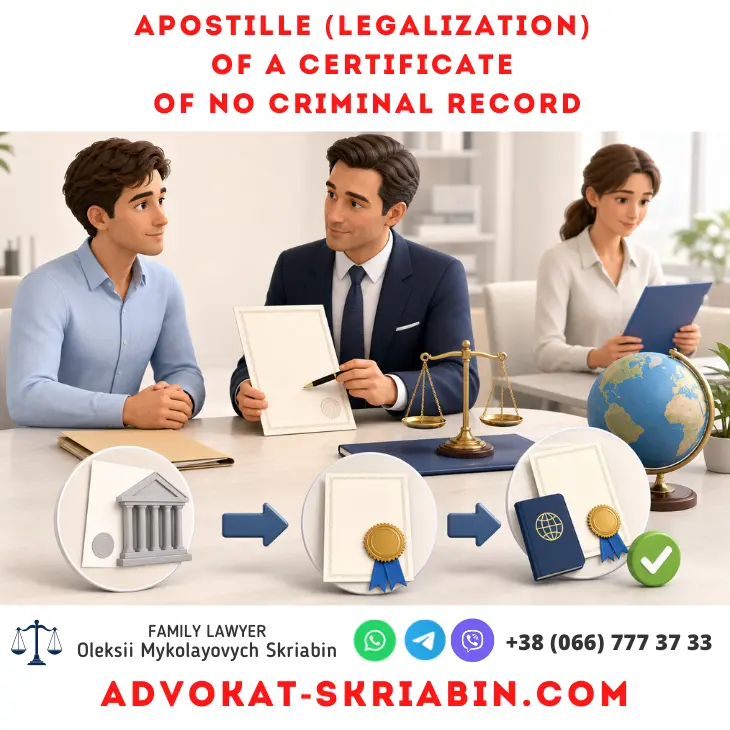
An apostille of a police clearance certificate is a special form of legalization confirming that the Ukrainian document was issued by a competent authority and can be presented in a foreign country that recognizes apostille under the Hague Apostille Convention. In practice, the apostille does not confirm the personal facts stated in the certificate; it confirms the official origin of the document.
A police clearance certificate is also often called a criminal record certificate, certificate of no criminal record, police certificate, or extract confirming the absence or presence of criminal liability information. For international use, the wording may differ depending on the receiving country, but the legal purpose remains similar: the foreign authority wants an official Ukrainian document that can be trusted.
The key phrase for many applicants is apostille police clearance certificate Ukraine, because the procedure must be done in the country where the document was issued. If the certificate is Ukrainian, the legalization must follow Ukrainian rules, even if the applicant currently lives in Poland, Germany, Canada, the United States, the United Kingdom, or another country.
When Do You Need an Apostille for a Criminal Record Certificate
You may need an apostille criminal record certificate Ukraine when a foreign institution asks you to prove that you have no criminal record or to provide official information about your criminal liability status. This usually happens when a person applies for immigration, a residence permit, permanent residence, citizenship procedures, employment in a regulated profession, study abroad, adoption, marriage registration, or long-term visa procedures.
The receiving authority may refuse a simple electronic or paper certificate if it is not legalized. A common mistake is to obtain the police clearance certificate for use abroad, translate it, and send it without apostille. In many countries, this creates a problem because the translation only explains the text, while the apostille confirms the official legal origin of the Ukrainian document.
Another practical issue is timing. Some foreign institutions accept police clearance certificates only if they were issued recently. Therefore, it is important to check the requirements of the country and institution before ordering the document, apostille, and translation.
Which Countries Accept an Apostilled Police Clearance Certificate
An apostilled police clearance certificate is generally accepted in countries that are parties to the Hague Apostille Convention. This includes many European countries and many non-European jurisdictions. However, acceptance always depends on the rules of the receiving authority, so the applicant should verify whether the country requires apostille, consular legalization, certified translation, notarized translation, or a sworn translator.
For example, one country may accept a Ukrainian police clearance certificate apostille with a certified translation into its official language. Another country may require translation after apostille, so that both the certificate and the apostille stamp are translated. A third country may have its own format requirements for migration or employment files.
The safest approach is not to rely only on general internet advice. Before submitting documents abroad, check the official instructions of the embassy, migration service, university, employer, court, civil registry office, or other receiving authority.
How to Obtain a Police Clearance Certificate in Ukraine
To obtain a police clearance certificate in Ukraine, the applicant usually needs to request official information about criminal liability, absence or presence of criminal record, or procedural restrictions. The request may be connected with employment, visa, immigration, citizenship, adoption, residence permit, marriage, or other legal purposes.
The certificate may be requested in electronic or paper form depending on the procedure available at the time of application and the purpose for which the document is needed. For apostille, the paper form is usually important because apostille is placed on a document that can be physically legalized.
Before ordering the certificate, it is important to choose the correct purpose of issue. A certificate prepared for domestic use may not always be convenient for foreign submission. If the document is needed abroad, the applicant should make sure that the form, language requirements, apostille, and translation sequence correspond to the rules of the receiving country.
How to Get an Apostille on a Police Clearance Certificate
To get an apostille on a police clearance certificate, the document must first be properly issued by the competent Ukrainian authority. After that, it is submitted for apostille legalization to the body authorized to apostille this category of documents. For documents connected with the Ministry of Internal Affairs, the apostille procedure is handled through the relevant official channel.
The apostille confirms the signature, capacity of the official, and authenticity of the seal or stamp on the public document. It does not replace the content of the police certificate and does not create a new certificate. This distinction matters because some applicants believe that apostille changes or “strengthens” the facts in the document. In reality, apostille only makes the Ukrainian public document acceptable abroad under the relevant international procedure.
If the applicant is outside Ukraine, the process can often be organized through a representative. This is especially useful when the person cannot travel to Ukraine only to obtain apostille on a police certificate Ukraine. Official information about apostille services for documents issued within the system of the Ministry of Internal Affairs can be checked on the website of the Ministry of Internal Affairs of Ukraine.
What Documents Are Required for Apostille Legalization
For apostille legalization of a police clearance certificate, the required package usually includes the original police clearance certificate in paper form, the applicant’s identity details, and payment confirmation if an official fee applies. Depending on the situation, additional documents may be needed to verify the applicant’s data, previous surname, foreign passport details, or representative authority.
If the person changed surname after marriage or divorce, it is important to check whether the foreign authority wants supporting documents proving the name change. This is common when the police clearance certificate contains one spelling of the name, while the foreign passport, marriage certificate, divorce decision, or residence card contains another spelling.
A lawyer can review the documents before submission and reduce the risk of rejection. A lawyer represents the client’s interests on the basis of a legal assistance agreement, which may be concluded online. A power of attorney is not required for this. If documents must be collected or clarified through official channels, an attorney request in family law cases may help obtain information needed for the broader legal file.
Apostille or Consular Legalization: Which Procedure Applies
Apostille and consular legalization are not the same procedure. Apostille is usually used when the document is intended for a country that accepts apostilled public documents under the Hague Apostille Convention. Consular legalization may apply when the destination country does not accept apostille or requires another legalization route.
This distinction is important because legalization of a police clearance certificate for the wrong country can waste time and money. If the receiving country requires consular legalization, an apostille may not be enough. If the country accepts apostille, consular legalization may be unnecessary.
Before preparing documents, the applicant should identify the destination country and the exact institution where the document will be submitted. Legalization is always practical, not abstract: the right procedure depends on where and why the police clearance certificate will be used.
Do You Need a Certified Translation After Apostille
In most foreign procedures, apostille and translation of police clearance certificate go together. Apostille confirms the official origin of the Ukrainian document, while translation makes the text understandable to the foreign authority. However, the order of these steps matters.
Often, the apostille is placed first, and then the certificate together with the apostille is translated. This allows the translator to translate both the content of the certificate and the apostille itself. In some countries, the translation must be certified by a notary, sworn translator, court translator, embassy, or another authorized professional.
A frequent mistake is translating the certificate before apostille and then discovering that the apostille also needs translation. This can create extra expenses and delays, especially if the applicant is already abroad and must submit the document within a short deadline.
Processing Time for an Apostille of a Police Clearance Certificate
Processing time for an apostille of a police clearance certificate depends on several factors: how quickly the certificate is issued, whether the paper original is available, whether there are technical or administrative delays, and whether translation is also required. The timeline may also depend on the workload of the competent authority and the method of document submission.
Applicants living abroad should add delivery time to the general timeline. If the document must be sent from Ukraine to another country, courier delivery, local translation, and appointment dates at foreign authorities should be considered in advance.
The best practical strategy is to start the process before the foreign deadline becomes urgent. If the receiving authority has a validity period for the police clearance certificate, the applicant should plan the apostille and translation so that the document remains acceptable at the time of submission.
Cost of Apostille and Legalization Services in Ukraine
The cost of apostille and legalization services in Ukraine may include official fees, document preparation, representative assistance, translation, notarization or certification of translation, courier delivery, and additional services if the applicant needs urgent processing or complex document review. Exact amounts may change, so they should be checked at the time of application.
The total cost also depends on the destination country. Some countries require only apostille and translation. Others may require additional certification, specific translator status, or submission through a particular authority. Because of this, the cheapest option is not always the most reliable one.
For legal and migration files, the main goal is not simply to obtain the lowest price, but to prepare a document package that will actually be accepted abroad. Before ordering several related services, the applicant may also clarify the cost of legal services in Ukraine and understand which actions are included in support.
Apostille of a Police Clearance Certificate for Residence Permit Applications
Apostille of a police clearance certificate for residence permit applications is one of the most common reasons Ukrainians request this service. Foreign migration authorities often need confirmation that the applicant has no criminal record in Ukraine or that there is no relevant criminal liability information.
The requirements may differ depending on whether the person applies for temporary residence, permanent residence, family reunification, employment-based residence, study residence, or humanitarian status. Some authorities may ask for a certificate issued within a limited period, while others may focus on apostille and translation requirements.
If the residence permit deadline is close, it is better to check all requirements before ordering the certificate. This helps avoid a situation where the apostille criminal record certificate is ready, but the translation, name spelling, or document purpose does not match the migration authority’s instructions.
Apostille for Employment, Study, Marriage, and Immigration Abroad
Apostille police certificate Ukraine may be required for employment abroad, especially in education, healthcare, childcare, finance, public service, security, and other fields where background checks are standard. Employers or licensing bodies may request the document before signing a contract or issuing permission to work.
For study abroad, a police clearance certificate may be needed for visa procedures, dormitory residence, internships, professional practice, or long-term stay. For marriage abroad, the document may be requested by civil registry authorities, especially when the foreign country checks personal status and legal capacity more broadly. In some family situations, the applicant may also need a certificate of marital status in Ukraine together with apostille and translation.
For immigration procedures, the certificate is often part of a larger file that may include birth certificates, marriage certificates, divorce documents, court decisions, apostilles, translations, and proof of identity. In such cases, legal review of the full document package is more effective than preparing each document separately.
Can You Obtain an Apostille Without Personal Presence
Yes, in many cases it is possible to obtain apostille on police clearance certificate online or remotely, without personal presence in Ukraine. This is especially important for Ukrainians who live abroad, cannot travel, or need the document for a foreign authority within a limited time.
Remote support usually includes checking the applicant’s situation, preparing the request, coordinating receipt of the certificate, arranging apostille, organizing translation if needed, and sending the finalized document to the client or directly for further use. When the issue is connected with a family case, online participation of a lawyer in family cases can make the process clearer for a client living abroad.
Personal presence may still be needed in some exceptional situations, for example if the receiving country requires a specific form of identity verification or if there are discrepancies in personal data. That is why preliminary document review is important before starting the process.
Online Apostille Services for Ukrainians Living Abroad
Online apostille services for Ukrainians living abroad are designed for people who need Ukrainian documents for use in another country but cannot come to Ukraine personally. This may include citizens working abroad, students, spouses in international marriages, migrants applying for residence permits, or people preparing documents for foreign courts and authorities.
The online divorce service can also coordinate document-related assistance when apostille is needed together with family-law documents, divorce decisions, civil status certificates, or translations for foreign use. This is especially relevant when a person is dealing with several legal issues at the same time and needs one clear plan.
For the client, the main advantage is predictability. Instead of trying to understand several state procedures, translation rules, and foreign requirements alone, the person receives a structured route: which document is needed, where it must be apostilled, whether translation is required, and how it can be delivered abroad.
Legal Assistance with Apostille of a Police Clearance Certificate
Legal assistance with apostille of a police clearance certificate helps reduce the risk of mistakes in document purpose, format, apostille route, translation sequence, and submission abroad. This is particularly important when the certificate is needed for immigration, residence permit, employment, marriage, study, or court-related procedures.
A lawyer can explain whether apostille or consular legalization applies, check the applicant’s personal data, review previous surname changes, coordinate translation, and advise how the document should be prepared for the receiving country. If several documents are needed, legal assistance also helps organize them in the correct order.
The online divorce service may provide support not only in divorce and family-law matters, but also in related document legalization issues when Ukrainian documents must be used abroad. For Ukrainians living outside Ukraine, this can save time, reduce stress, and make the procedure more understandable.
Step-by-Step Instruction
- Define the country and institution where the police clearance certificate will be submitted. This determines whether apostille, consular legalization, certified translation, or another requirement applies.
- Check whether the receiving authority requires a police clearance certificate for use abroad and whether it has a validity period, specific wording, paper format, or translation rule.
- Obtain the Ukrainian police clearance certificate in the proper form. If apostille is required, make sure the document can be submitted for apostille legalization.
- Submit the police clearance certificate for apostille through the competent Ukrainian authority or through a representative acting under a legal assistance agreement.
- Arrange certified translation if the foreign authority requires it. In many cases, the certificate and apostille should be translated together after apostille is placed.
- Review the final document package before sending it abroad. Check names, dates, document purpose, apostille, translation, certification, and delivery details.
- Submit the document to the foreign authority within the required timeframe and keep copies or scans for your records.
Apostille of a Court Decision on Divorce in Ukraine: Legalization for Use Abroad
Apostille of a court decision on divorce in Ukraine is a separate but closely related service for people who need to prove abroad that their marriage was legally dissolved by a Ukrainian court. This may be required for remarriage, residence permit applications, citizenship procedures, civil status registration, property matters, or family-law cases in another country.
Unlike a police clearance certificate, a divorce court decision belongs to another category of official documents. Therefore, the competent authority for apostille may differ. The applicant must usually obtain a proper court decision copy, confirm that it has entered into legal force if required, and then arrange apostille and translation for the destination country.
This block is important because foreign authorities often request several Ukrainian documents at once: police clearance certificate, birth certificate, marriage certificate, divorce decision, apostille, and certified translation. If the applicant does not yet have the correct court document, it is important to understand how to obtain a court decision on divorce before starting legalization.
Useful materials on the site advokat-skriabin.com
- Obtain a court decision on divorce
- Obtain a court decision on alimony
- Obtain a writ of execution for alimony
- Prohibition on a child’s travel abroad
- Establishing the fact of birth in the occupied territory
- Establishing the fact of death in the occupied territory
- Establishing paternity
- Establishing the fact of living together as one family without registering a marriage
- Establishing the fact of independent upbringing of a child
- Divorce lawyer