- What Is a Foreign Divorce and Is It Valid in Ukraine
- Do You Need to Register a Foreign Divorce in Ukraine
- When Is Foreign Divorce Recognition Automatic
- When Must You Apply to a Ukrainian Court
- Recognition of a Foreign Court Divorce Decision in Ukraine
- What Documents Are Required to Register a Foreign Divorce
- Do You Need an Apostille or Legalization
- How to Translate Foreign Divorce Documents for Ukraine
- Step-by-Step Process to Register a Divorce Obtained Abroad
- How to Register a Polish Divorce in Ukraine
- Recognition of Divorce from the USA, Germany, Canada and Other Countries
- Can You Register a Foreign Divorce Online
- Common Mistakes When Recognizing a Foreign Divorce
- How Long Does Recognition of a Foreign Divorce Take
- How a Family Lawyer Can Help with Foreign Divorce Recognition
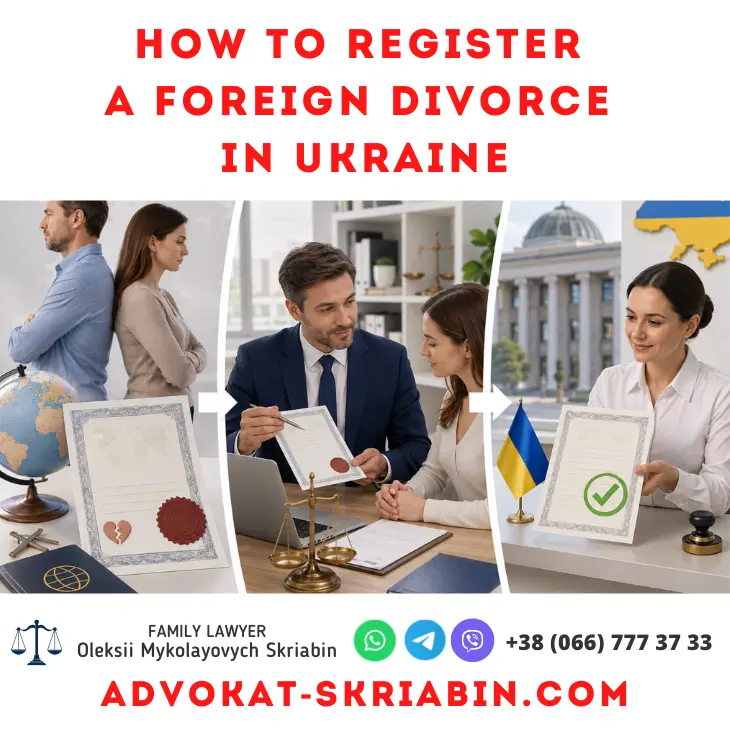
What Is a Foreign Divorce and Is It Valid in Ukraine
A foreign divorce is a divorce granted outside Ukraine by a foreign court, civil registry authority, family court, administrative authority, or another institution authorized under the laws of that country to terminate a marriage.
In many situations, a foreign divorce in Ukraine can be recognized without starting a new divorce case. Ukrainian authorities generally focus on whether the foreign decision was issued lawfully and whether recognition does not contradict Ukrainian public policy.
The fact that a marriage was dissolved abroad does not automatically mean that all Ukrainian authorities will immediately update records. In some cases, additional procedural steps are required before the divorce can be fully reflected in Ukrainian legal records. Whether you need further action depends on the country involved, the type of divorce document issued, and the rules governing recognition of a foreign court decision on divorce in Ukraine.
Do You Need to Register a Foreign Divorce in Ukraine
Many people assume that once they receive a foreign divorce certificate or court judgment, no further steps are necessary. In practice, this is not always correct. If you intend to remarry in Ukraine, update personal documents, resolve inheritance matters, or prove your marital status before Ukrainian authorities, you may need to complete a registration or recognition procedure.
The phrase “register a divorce obtained abroad” can refer to different legal actions. Sometimes it means updating civil status records. In other cases, it means obtaining official recognition of a foreign divorce judgment through Ukrainian legal procedures. The need for registration often becomes apparent only when a government agency requests confirmation that the foreign divorce is recognized in Ukraine.
When Is Foreign Divorce Recognition Automatic
In some circumstances, foreign divorce recognition in Ukraine occurs without separate court proceedings. Automatic recognition is more common when international treaties between Ukraine and another state provide simplified recognition procedures. Certain foreign civil status documents may also be accepted directly after proper authentication and translation.
The specific outcome depends on the country where the divorce was finalized and the nature of the document issued. A divorce certificate issued by a civil authority may be treated differently from a court judgment.
Even when recognition appears automatic, Ukrainian authorities may still require properly authenticated documents, certified translations, and proof that the foreign decision has entered into legal force. For this reason, it is important to verify requirements before submitting documents to avoid unnecessary delays.
When Must You Apply to a Ukrainian Court
A court procedure may become necessary when automatic recognition is unavailable or when Ukrainian authorities require formal confirmation of the foreign decision. This situation commonly arises when the divorce was granted by a foreign court and no simplified recognition mechanism applies. The Ukrainian court does not reconsider whether the spouses should divorce. Instead, it examines whether the foreign decision satisfies legal requirements for recognition.
Court recognition may also be required if questions arise regarding jurisdiction, notification of the parties, procedural fairness, or compliance with Ukrainian public policy principles. Individuals living abroad often worry about personal attendance. In many cases, legal representation can significantly simplify the process and reduce the need for travel to Ukraine. Attention: A lawyer represents the client’s interests based on a legal assistance agreement, which may be concluded online. A power of attorney is not required for this purpose.
Recognition of a Foreign Court Divorce Decision in Ukraine
Recognition of a foreign court divorce decision in Ukraine is a separate legal procedure from obtaining a divorce itself. The marriage has already been terminated abroad; the Ukrainian court merely determines whether the foreign judgment can produce legal effects in Ukraine.
The court reviews submitted documents and verifies compliance with procedural requirements. It is not a new divorce lawsuit and does not involve determining fault, division of property, or child custody issues unless separate proceedings are initiated.
One of the most important aspects is demonstrating that the foreign judgment is final and legally enforceable in the country where it was issued. Evidence of finality is often required as part of the application package.
When prepared correctly, recognition proceedings are generally more straightforward than a full family law dispute, especially if the applicant already understands the legal effect of a court decision on divorce in Ukrainian legal practice.
What Documents Are Required to Register a Foreign Divorce
The required documentation depends on the country involved and the type of foreign divorce document being presented. In most cases, applicants should prepare the foreign divorce judgment or divorce certificate, evidence that the decision entered into legal force, identification documents, and properly translated copies.
Authorities may also request documents confirming the names of the parties, previous marital status records, or other supporting materials necessary to establish legal continuity. The quality of document preparation is often decisive. Incomplete applications, translation mistakes, missing authentication, or incorrect certifications frequently result in delays. Before submitting documents, it is advisable to verify whether additional country-specific requirements apply.
Do You Need an Apostille or Legalization
One of the most common questions concerns the need for an apostille on divorce decree documents. The answer depends largely on the country where the divorce was granted and the international agreements applicable to that country. Some documents require an apostille before they can be used in Ukraine. Others may require consular legalization. Certain documents may be exempt due to international treaties.
An apostille confirms the authenticity of a public document for use abroad. It does not verify the contents of the divorce decision itself but allows Ukrainian authorities to rely on the document’s official origin.
Mistakes regarding authentication requirements are among the most common reasons applications are rejected or returned for correction. Therefore, before attempting to legalize foreign divorce documents, applicants should determine which authentication procedure applies to their specific country. For official information connected with apostille, civil status records, and registration actions, applicants may also check the Ministry of Justice of Ukraine.
How to Translate Foreign Divorce Documents for Ukraine
Foreign divorce documents submitted to Ukrainian authorities generally require translation into Ukrainian. Translations must accurately reflect names, dates, court details, procedural terminology, and all legally significant information contained in the original documents. Even minor translation inconsistencies can create problems when matching records in Ukrainian databases.
In many situations, notarization of the translation is also required. Authorities may refuse documents if translations are incomplete, uncertified, or contain obvious inaccuracies. Special attention should be given to transliteration of personal names because differences between passports, civil status records, and translated documents can create additional procedural complications. For international family law matters, professional legal review of translations before submission often helps prevent avoidable delays and requests for corrections.
Step-by-Step Process to Register a Divorce Obtained Abroad
The exact procedure may vary depending on the country where the divorce was granted, but the overall process follows a similar structure. Understanding each stage in advance helps avoid delays and unnecessary document requests.
Many applicants begin the process only after discovering that Ukrainian authorities still require confirmation of their marital status. Preparing documents correctly from the start can significantly simplify foreign divorce recognition in Ukraine.
Step-by-Step Instruction
- Obtain the final divorce document. Receive the official divorce judgment, divorce certificate, or another document confirming that the marriage has been legally dissolved in the foreign country.
- Confirm legal validity. Make sure the divorce document has entered into legal force and can be used for international purposes. Some jurisdictions issue separate certificates confirming finality.
- Complete authentication. If required, obtain an apostille on divorce decree documents or complete consular legalization according to the applicable international rules.
- Arrange translation. Prepare a professional Ukrainian translation of all foreign divorce documents and complete notarization if required.
- Determine the recognition procedure. Identify whether recognition of divorce from another country can occur automatically or whether a Ukrainian court application is necessary.
- Submit the documents. Provide the documents to the appropriate authority or court, depending on the circumstances of the case.
- Update legal records. After successful recognition, update civil status information and use the recognized divorce documents for future legal procedures in Ukraine.
How to Register a Polish Divorce in Ukraine
Poland is one of the countries most frequently involved in international family law matters concerning Ukrainian citizens. As a result, requests regarding recognition of Polish divorces arise regularly.
A divorce granted in Poland may be recognized in Ukraine, but the procedure depends on the type of decision issued and the applicable legal framework. In some cases, recognition can proceed relatively smoothly if all documentation is properly prepared.
Applicants should ensure that the Polish divorce judgment is final, authenticated when necessary, and translated into Ukrainian. Particular attention should be paid to court stamps, confirmation of legal force, and the accuracy of translated personal information.
Because many Ukrainians currently reside in Poland, legal issues often arise years after the divorce, especially when a person wishes to remarry or update official records in Ukraine. In such cases, earlier information about divorce in Poland for Ukrainians can help understand how the foreign procedure may later affect Ukrainian documents.
Recognition of Divorce from the USA, Germany, Canada and Other Countries
Recognition of a foreign divorce judgment follows similar legal principles regardless of whether the divorce originated in the United States, Germany, Canada, the United Kingdom, Italy, Spain, France, or another jurisdiction.
However, each country has its own documentation standards, court procedures, certification requirements, and methods of confirming that a judgment has become final. Therefore, identical-looking cases may require different supporting documents.
One common mistake is assuming that all foreign divorce certificates are treated equally. Ukrainian authorities often distinguish between administrative divorces, court judgments, civil registry records, and family court decisions.
Individuals who obtained a divorce outside Europe should pay particular attention to authentication requirements and document formatting before attempting to register a divorce obtained abroad in Ukraine. This is especially relevant for people who previously completed a divorce in the USA for Ukrainians and now need the result to be legally accepted by Ukrainian authorities.
Can You Register a Foreign Divorce Online
Modern legal procedures increasingly allow individuals to handle family law matters remotely. This is especially important for Ukrainians who permanently reside outside the country. Many preparatory stages can be completed online, including consultations, document review, translation coordination, preparation of applications, and communication with legal representatives.
Where court proceedings are required, substantial portions of the process may also be organized remotely through legal representation. Attention: A lawyer represents the client’s interests based on a legal assistance agreement, which may be concluded online. A power of attorney is not required for this purpose.
For individuals living abroad, online support often eliminates the need for repeated travel to Ukraine while ensuring compliance with procedural requirements. The Online Divorce Service regularly assists clients who need recognition of a foreign court decision in Ukraine while remaining outside the country.
Common Mistakes When Recognizing a Foreign Divorce
Errors during recognition procedures can significantly increase processing time and create additional expenses. The most frequent problem is submitting documents that have not been properly authenticated. Many applicants discover too late that an apostille, legalization, or additional certification was required before documents could be accepted.
Another common issue involves inaccurate translations. Differences in spelling, incomplete translations, omitted pages, or inconsistent transliteration of names often lead to requests for corrections.
Applicants also frequently misunderstand the distinction between automatic recognition and situations requiring court involvement. Filing documents with the wrong authority may result in delays and procedural complications.
Finally, some individuals wait until they need to remarry or complete another urgent legal action before addressing recognition. Early preparation generally prevents last-minute difficulties, especially when documents require apostille and legalization of a divorce certificate before they can be used in Ukraine.
How Long Does Recognition of a Foreign Divorce Take
The duration of the process depends on several factors, including the country where the divorce was granted, the completeness of the documents, authentication requirements, translation needs, and whether court recognition is necessary.
When documents are prepared correctly and no procedural obstacles arise, recognition can proceed relatively efficiently. However, missing certifications, translation errors, or incomplete applications often extend the timeline considerably.
Court proceedings naturally require additional time because the court must review submitted materials and ensure compliance with Ukrainian procedural standards. Applicants should therefore begin collecting documents as early as possible rather than waiting until recognition becomes urgently necessary for another legal transaction.
How a Family Lawyer Can Help with Foreign Divorce Recognition
International family law matters often involve several legal systems simultaneously. Even seemingly straightforward cases may require analysis of foreign documents, international agreements, authentication requirements, and Ukrainian procedural rules.
A family lawyer can evaluate whether court recognition is required, determine which documents must be obtained abroad, review translations, and identify potential procedural risks before submission. Professional assistance is particularly valuable when documents originate from multiple countries, when records contain discrepancies, or when Ukrainian authorities request additional evidence.
For clients living outside Ukraine, legal representation can significantly reduce the administrative burden associated with foreign divorce recognition in Ukraine and help avoid avoidable delays. Attention: A lawyer represents the client’s interests based on a legal assistance agreement, which may be concluded online. A power of attorney is not required for this purpose. A client may also need broader support from an international lawyer when the case involves documents, courts, or public authorities of several countries at the same time.
Phone / Viber / WhatsApp / Telegram: +380667773733
Email: skriabinadvokat@gmail.com