
- What Is Legalization of Documents for Portugal and When Is It Required
- Does Portugal Require an Apostille on Ukrainian Documents
- How to Get an Apostille for Portugal in Ukraine
- Which Ukrainian Documents Can Be Apostilled for Portugal
- Certified Translation of Documents for Portugal
- Legalization of Birth Certificates for Portugal
- Legalization of Marriage and Divorce Certificates for Portugal
- Apostille of Criminal Record Certificates for Portugal
- Apostille and Recognition of Diplomas for Portugal
- Legalization of Court Decisions and Legal Documents for Portugal
- Documents Required for Residence Permit and Citizenship in Portugal
- How Ukrainian Documents Are Recognized in Portugal
- Processing Times and Cost of Legalization for Portugal
- Remote Legalization of Documents for Portugal Without Personal Presence
- Legal Assistance with Apostille, Translation and Document Preparation for Portugal
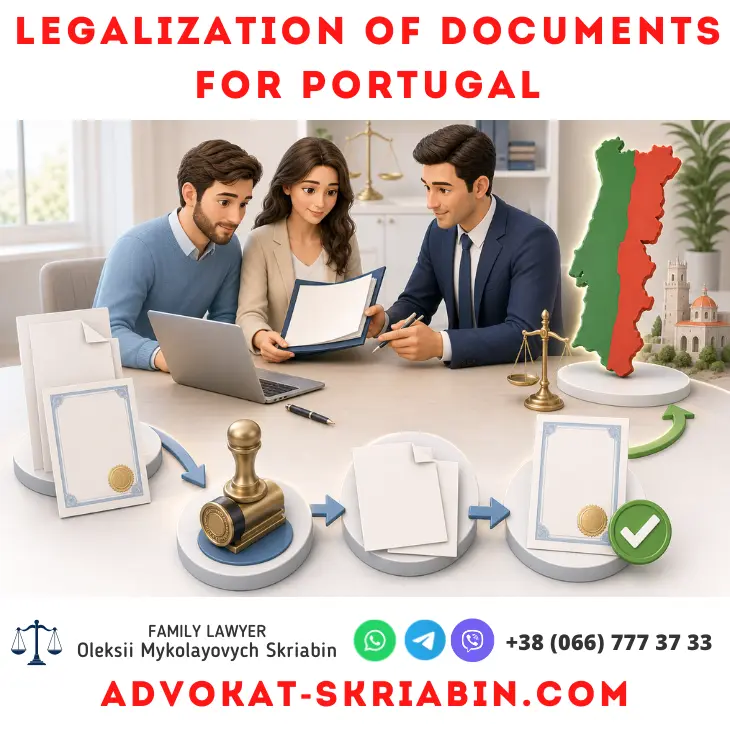
What Is Legalization of Documents for Portugal and When Is It Required
Legalization of documents for Portugal is the preparation of Ukrainian documents so they can be accepted by Portuguese authorities, institutions or private organizations. In practice, this usually means checking the document, obtaining an apostille when required, preparing a certified translation and making sure the document format matches the purpose of submission.
This process may be needed for residence permit applications, citizenship procedures, employment, education, marriage registration, divorce matters, child-related procedures, inheritance, banking, tax registration or court issues. The exact requirement depends on the Portuguese authority that will receive the document.
A common mistake is to think that a Ukrainian document automatically works abroad because it is valid in Ukraine. For Portugal, the document often needs an additional confirmation of origin and a translation that can be understood by the receiving authority.
Does Portugal Require an Apostille on Ukrainian Documents
Portugal and Ukraine use the apostille system for many public documents. An apostille confirms the official origin of the document, the authority of the person who signed it and the official seal or stamp. It does not confirm that the facts inside the document are true for all legal purposes.
For example, if a Ukrainian birth certificate is issued by the competent authority, an apostille helps the Portuguese authority understand that the document comes from an official Ukrainian source. After that, translation of documents for Portugal may still be required.
Not every document is apostilled in the same way. Civil status documents, court documents, educational documents and notarial documents may go through different competent authorities in Ukraine, including procedures related to the Ukrainian Ministry of Justice.
How to Get an Apostille for Portugal in Ukraine
To get an apostille for Portugal in Ukraine, the first step is to identify the type of document and the authority that issued it. This matters because different documents are processed through different Ukrainian authorities.
The second step is to check whether the document is original, whether it is still readable, whether the seal and signature are clear, and whether the Portuguese side accepts this document type. If the document is damaged, outdated or issued in an old format, it may be better to obtain a duplicate before apostille.
After that, the document is submitted for apostille. When the apostille is ready, the next practical step is usually certified translation for Portugal. In many cases, the translation must be prepared carefully because even small differences in names, dates, places of birth or marital status can create problems.
Which Ukrainian Documents Can Be Apostilled for Portugal
Ukrainian documents for Portugal may include civil status certificates, court decisions, notarial statements, criminal record certificates prepared online, educational documents and other official papers. The main rule is simple: the document must be issued or properly certified by a competent Ukrainian authority.
Most often, clients prepare birth certificates, marriage certificates, divorce certificates, court decisions on divorce, criminal record certificates, diplomas, academic transcripts, powers of attorney, consent statements and documents connected with children.
Before ordering apostille documents for Portugal, it is important to understand the final purpose. The same Ukrainian document may be prepared differently for a residence permit, marriage in Portugal, university admission, citizenship file or family court matter.
Certified Translation of Documents for Portugal
Certified translation for Portugal is not just a literal translation of words. It is a legally important adaptation of the document into the language and format expected by the receiving authority. Names, surnames, places, dates and legal terms must be translated consistently.
A frequent problem appears when one person’s name is written differently in several documents. For example, a passport, birth certificate and marriage certificate may contain different transliteration versions. This should be checked before submission, because Portuguese authorities may ask for clarification or additional documents.
Translation of documents for Portugal should be prepared after understanding where the documents will be filed. Requirements may differ depending on whether the documents are submitted to migration authorities, universities, registry offices, courts, banks or other institutions.
Legalization of Birth Certificates for Portugal
Apostille birth certificate for Portugal is commonly required for residence, citizenship, family reunification, child registration, school matters, inheritance and other personal status procedures. A birth certificate confirms the person’s identity, date of birth and family connection.
If the certificate is old, damaged or issued in a format that may be difficult to verify, it may be advisable to obtain a duplicate in Ukraine. After that, the document can be apostilled and translated for use in Portugal.
For children, special attention should be paid to the spelling of parents’ names. If the child’s documents, parents’ passports and other family documents contain different spellings, the package should be reviewed before filing.
Legalization of Marriage and Divorce Certificates for Portugal
Marriage and divorce documents are often needed when a person wants to register family status in Portugal, remarry, apply for residence, confirm a spouse relationship or resolve family matters abroad. Legalization of Ukrainian documents in Portugal may include apostille, translation and submission to the relevant authority.
If the marriage or divorce was registered by a Ukrainian civil registry authority, the certificate may usually be prepared through apostille and translation. If the divorce was completed through court, the court decision may be required instead of, or together with, civil registry documents.
When the matter is connected with divorce, children or family status, the Service for Online Divorce can help review which Ukrainian family documents should be prepared for Portugal and whether additional legal documents are needed, especially when the situation is related to divorce procedure in Portugal for Ukrainians.
Apostille of Criminal Record Certificates for Portugal
Criminal record certificate for Portugal is often requested for residence permits, citizenship, employment, professional licensing or other administrative procedures. This document must usually be recent enough for the receiving authority, so timing is important.
The certificate should be obtained in the correct format, checked for personal data accuracy, apostilled if required and translated according to the rules of the receiving authority. If the certificate is prepared too early, it may become unsuitable for the intended procedure.
For Ukrainian citizens abroad, this process is often stressful because they may need the document quickly and cannot easily return to Ukraine. Remote preparation can reduce delays if the document can be ordered, apostilled and translated through a representative.
Apostille and Recognition of Diplomas for Portugal
Educational documents may be needed for study, employment, professional recognition or continuation of education in Portugal. Diplomas, supplements and academic records often require careful preparation because education authorities may have specific requirements.
An apostille confirms the official origin of the Ukrainian educational document. However, recognition of the qualification in Portugal is a separate issue. A diploma may be apostilled and translated, but the receiving institution may still need to assess the level, program and academic rights.
Before preparing educational documents, it is useful to check whether Portugal requires only an apostilled diploma or also a supplement, transcript, program description or additional confirmation from the educational institution.
Legalization of Court Decisions and Legal Documents for Portugal
Court decisions and legal documents may be required for divorce recognition, custody matters, inheritance, debt issues, name changes, civil status confirmation or other legal procedures in Portugal. These documents need special attention because the receiving authority may require proof that the decision is final.
For example, a court decision may need a mark or confirmation that it has entered into legal force. If this is missing, the Portuguese authority may not understand whether the decision can be relied on, especially when the person needs to use a Ukrainian court decision on divorce abroad.
If a lawyer represents the client’s interests in Ukraine, the lawyer acts on the basis of a legal aid agreement, which may be concluded online. A power of attorney is not required for this type of legal representation.
Documents Required for Residence Permit and Citizenship in Portugal
For residence permit and citizenship procedures in Portugal, Ukrainian citizens may be asked to provide identity documents, birth certificates, marriage or divorce documents, criminal record certificates, documents confirming family ties, education documents or other papers depending on the legal basis of the application.
There is no universal package for every person. A student, employee, spouse, parent, investor or applicant for citizenship may need different documents. That is why legalization of documents online for Portugal should begin with understanding the specific procedure.
A practical approach is to make a document checklist before ordering apostille and translation. This reduces the risk of preparing unnecessary documents while missing the document that is actually required.
How Ukrainian Documents Are Recognized in Portugal
Recognition of Ukrainian documents in Portugal usually depends on three elements: whether the document is official, whether it is properly apostilled or legalized, and whether the receiving authority accepts the translation. Some documents are accepted for information purposes, while others require a separate recognition procedure.
For example, a birth certificate may confirm family connection, but a diploma may need academic recognition. A court decision may require additional confirmation that it is final and suitable for use abroad.
Legalization of Ukrainian documents in Portugal should therefore be seen as a preparation stage, not always the final legal result. The final decision belongs to the Portuguese authority, institution or court reviewing the file.
Processing Times and Cost of Legalization for Portugal
Processing time depends on the type of document, the authority involved, the need to obtain duplicates, apostille workload, translation complexity and delivery method. Civil status documents may be faster, while court or educational documents can take more time.
The cost also depends on the number of documents, type of apostille, translation requirements, notarial certification, courier delivery and urgency. It is better not to rely on general prices without reviewing the actual documents. The safest approach is to send scanned copies for preliminary review. After that, it is possible to estimate the scope of work, likely timing and practical steps for apostille documents for Portugal.
Remote Legalization of Documents for Portugal Without Personal Presence
Remote legalization of documents for Portugal is useful for Ukrainians who live abroad, cannot visit Ukraine, have limited time or need to prepare documents for several family members. Many stages can be coordinated online if the original documents can be delivered or if duplicates can be obtained in Ukraine.
The remote process usually includes document review, confirmation of the purpose, preparation of missing Ukrainian documents, apostille, certified translation and delivery. Communication may be handled online, which is convenient for people living in Portugal or another country.
Legalization of documents online for Portugal is especially helpful when the person needs Ukrainian documents for residence, citizenship, marriage, divorce, children’s documents or administrative procedures and cannot personally manage each authority.
Legal Assistance with Apostille, Translation and Document Preparation for Portugal
Legal assistance helps avoid common mistakes: apostilling the wrong document, translating before checking the final requirements, using inconsistent transliteration, missing proof that a court decision is final, or preparing documents that are not accepted by the Portuguese authority.
A lawyer can review the situation, identify the necessary documents, explain the sequence of apostille and translation, and coordinate preparation in Ukraine. This is especially important when the documents are connected with family status, children, court decisions, residence or citizenship.
The Service for Online Divorce may assist when Ukrainian documents for Portugal are connected with marriage, divorce, family status, children or recognition of legal documents abroad. You may request a consultation, send documents for review and receive a clear plan of action.
Step-by-step instruction
- Define where the document will be submitted in Portugal and what legal purpose it must serve.
- Check whether the Ukrainian document is original, readable, current and suitable for apostille.
- Confirm whether a duplicate, court confirmation or additional certificate is needed before apostille.
- Submit the document for apostille through the competent Ukrainian authority.
- Prepare certified translation for Portugal after checking the spelling of names, dates and legal terms.
- Review the complete package before submission to the Portuguese authority.
- Arrange delivery or remote support if you live abroad and cannot handle the process personally, including situations where online participation of a lawyer in family matters is needed.
Useful materials on the site advokat-skriabin.com
- Legalization of documents for Georgia
- Legalization of documents for Italy
- Legalization of documents for Spain
- Legalization of documents for the Czech Republic
- Legalization of documents for Poland
- Legalization of documents for Germany
- Legal assistance in divorce for the defendant
- Obtain a birth certificate
- Obtain a marriage certificate
- Obtain a divorce certificate