- What Is Legalization and Apostille of Documents
- Apostille or Consular Legalization: What Is the Difference
- When Do Ukrainian Documents Require an Apostille
- Which Ukrainian Documents Can Be Apostilled
- Legalization of Documents for Use Abroad: Step-by-Step Process
- Translation and Apostille of Documents: Why Both May Be Required
- How to Obtain an Apostille While Living Abroad
- Apostille for Birth, Marriage and Divorce Certificates
- Apostille for Court Decisions, Diplomas and Criminal Record Certificates
- Which Countries Accept Apostille and Which Require Legalization
- Common Mistakes When Preparing Documents for International Use
- How Long Does Apostille and Legalization Take
- Can Apostille and Legalization Be Ordered Remotely
- Cost of Apostille, Translation and Legalization Services
- Legal Assistance with Apostille and Legalization of Documents
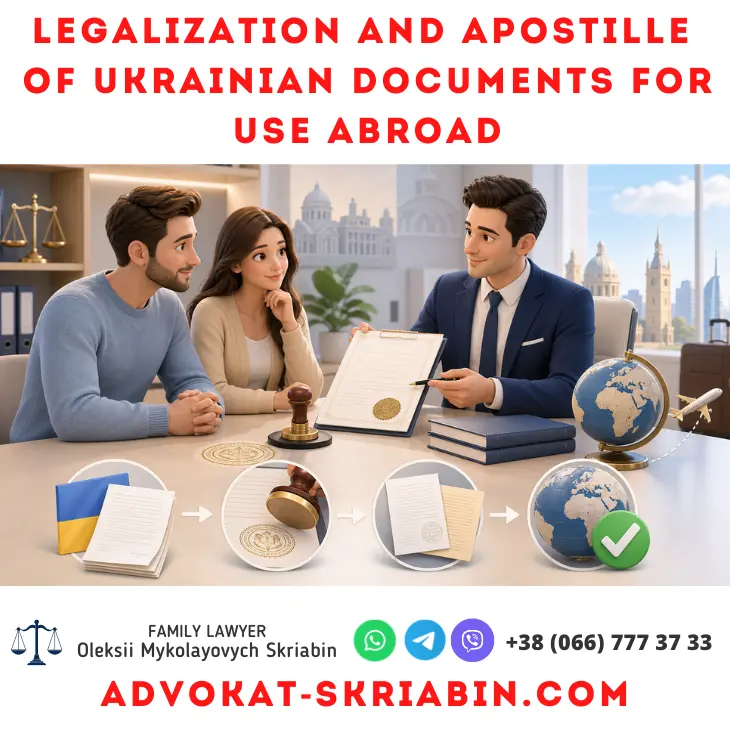

What Is Legalization and Apostille of Documents
Legalization of documents is a procedure that confirms that an official document issued in one country can be accepted by authorities, institutions or organizations in another country. For Ukrainian documents, this is especially important when a person needs to use a birth certificate, marriage certificate, divorce document, court decision, diploma, criminal record certificate or notarial document outside Ukraine.
Apostille of documents is a simplified form of international certification. It is used between countries that participate in the Hague Apostille Convention. Instead of passing through several diplomatic and consular stages, the document receives an apostille from the competent authority of the country where the document was issued.
In simple words, apostille confirms the official origin of the document, the authority of the signature and the status of the seal or stamp. It does not replace the content of the document and does not automatically translate it into another language. If a foreign authority cannot read Ukrainian, apostille and translation of documents may both be required.
For Ukrainian citizens living abroad, legalization of Ukrainian documents often becomes necessary when they already have a foreign procedure in progress. For example, a person may be asked to provide apostilled Ukrainian documents for marriage registration, residence permit renewal, employment, university admission, child-related procedures or recognition of a divorce.
Apostille or Consular Legalization: What Is the Difference
The main difference is the destination country. If the foreign country accepts apostille, the Ukrainian document usually needs an apostille for use abroad and, if required, translation. If the destination country does not accept apostille, the document may require consular legalization of documents.
Apostille is usually faster and simpler because it involves one certification step by the competent Ukrainian authority. Consular legalization is more complex because it may require several stages: preliminary certification, confirmation by the relevant Ukrainian authority and legalization through the consular channel of the country where the document will be used.
The mistake many people make is assuming that apostille is universal for every country. It is not. Apostille works only where the apostille system is recognized. For countries outside this system, legalization of documents for use abroad may require consular legalization instead.
Another important difference is the type of document. Educational documents, civil status documents, court decisions and notarial documents may fall under different Ukrainian authorities. Therefore, before ordering apostille online and remote processing, it is necessary to determine who issued the document and where it will be submitted.
When Do Ukrainian Documents Require an Apostille
Ukrainian documents usually require an apostille when they are submitted to a foreign state authority, court, consulate, university, employer, migration service, bank, notary, registry office or other official institution in a country that recognizes apostille. The purpose may be personal, family, educational, business or procedural.
For example, apostille of Ukrainian documents may be needed for marriage abroad, confirmation of divorce, registration of a child, inheritance, residence permit, citizenship application, university admission, employment abroad or recognition of qualifications.
Apostille may also be required when a Ukrainian court decision must be used abroad. This can include divorce judgments, decisions concerning children, recognition of facts, inheritance-related decisions or other judicial acts that foreign authorities need to verify.
Important: apostille confirms the origin and official status of the document, but it does not guarantee that the foreign authority will accept the document without additional requirements. Some institutions may also request a certified translation, a fresh extract, a notarized copy or a specific format of the document.
Which Ukrainian Documents Can Be Apostilled
Apostille may be placed on many official Ukrainian documents, but the procedure depends on the issuing authority and document type. Civil status documents, court documents, notarial documents, educational documents and certain official certificates are processed through different competent authorities.
Common examples include birth certificates, marriage certificates, divorce certificates, name change certificates, extracts from civil status registers, court decisions, diplomas, diploma supplements, academic certificates, criminal record certificates, powers of attorney, notarial statements and other official documents.
For family law matters, apostille is often needed for documents connected with marriage, divorce, children, change of surname, court decisions and confirmation of marital status. These documents are frequently requested abroad for immigration, remarriage, residence, social benefits or official registration.
Before submitting a document for apostille, it is necessary to check whether the document is valid for apostille in its current form. Some old, damaged, laminated or incorrectly issued documents may need to be replaced or reissued before legalization of Ukrainian documents can be completed.
Legalization of Documents for Use Abroad: Step-by-Step Process
The process starts with identifying the country where the document will be used. This is the key point because the country determines whether apostille of documents is enough or whether consular legalization of documents is required.
After that, the document type must be checked. A birth certificate, court decision, diploma and criminal record certificate may require different preparation, different competent authority and different additional documents. This is where many delays happen, especially if the person is abroad and does not know which Ukrainian body handles the document.
Then the original document, duplicate, extract or certified copy must be prepared in the correct form. If the foreign institution requires translation, the order of apostille and translation should be checked in advance. In some cases, the apostille is placed first and then translated; in other cases, a translation or notarized copy may need separate certification.
Step-by-step instruction
- Determine the country where the Ukrainian document will be submitted and check whether apostille or consular legalization is required.
- Identify the document type: civil status certificate, court decision, diploma, criminal record certificate, notarial document or another official document.
- Check whether the document is suitable for apostille in its current form or whether a new duplicate, extract or court-certified copy is needed.
- Prepare the document package, including passport details, application data and, if necessary, proof of representation or additional supporting documents.
- Submit the document to the competent authority or arrange apostille online and remote processing through a legal representative.
- Arrange certified translation if the foreign authority requires the document in another language.
- Receive the apostilled or legalized document and check names, dates, seals, signatures and translation accuracy before foreign submission.
Translation and Apostille of Documents: Why Both May Be Required
Apostille and translation of documents serve different purposes. Apostille confirms the official origin of the Ukrainian document, while translation makes its content understandable for the foreign authority. These procedures often work together but are not the same.
For example, a Ukrainian birth certificate may receive an apostille, but a registry office, migration authority or university abroad may still require a certified translation into the official language of that country. Without translation, the document may be formally certified but practically unusable.
The correct order matters. Some countries require translation after apostille so that both the document and apostille are translated together. Other institutions may have their own rules for notarization, sworn translation or certified translator format.
For this reason, legalization of documents for use abroad should not be treated as a mechanical stamp. It is a document strategy: country, authority, purpose, document type, apostille, translation and final submission must match each other.
How to Obtain an Apostille While Living Abroad
Ukrainian citizens living abroad often face the same problem: the document was issued in Ukraine, but the person is already in another country. In such cases, apostille of Ukrainian documents is usually handled in Ukraine because apostille is issued by the competent authority of the country where the document originated.
A foreign authority usually cannot apostille a Ukrainian document. It may accept it after Ukrainian apostille, but it does not replace the Ukrainian certification procedure. This is especially important for birth, marriage, divorce, education and court documents.
Remote processing can help when a person cannot travel to Ukraine. The client may send scans for preliminary review, receive a list of required documents, order duplicates or extracts if necessary, and arrange apostille and translation through a representative.
If legal representation is needed, the advocate represents the client’s interests on the basis of a legal assistance agreement, which may be concluded online. A power of attorney is not required for this type of legal representation. In family matters, this may also include an attorney’s request for family documents when official information or copies must be obtained in Ukraine.
Apostille for Birth, Marriage and Divorce Certificates
Birth, marriage and divorce certificates are among the most commonly apostilled Ukrainian documents. They are often required abroad for family reunification, marriage registration, residence permits, citizenship procedures, child registration, change of surname, inheritance and social matters.
Apostille for birth certificates may be needed when parents register a child abroad, confirm family ties, apply for residence documents or submit papers to educational, migration or social authorities. If the certificate is old or damaged, it may be safer to obtain a new duplicate or extract before apostille.
Marriage certificates are often required abroad to confirm marital status, apply for family-based residence, register property rights or submit documents to foreign administrative bodies. Divorce certificates and divorce-related court decisions may be needed for remarriage, immigration, child-related procedures or recognition of personal status, especially when a person plans marriage registration abroad as a Ukrainian citizen.
The Online Divorce Service may assist with documents connected to divorce, including preparation of court decisions for use abroad, apostille, translation and remote coordination when a client is outside Ukraine.
Apostille for Court Decisions, Diplomas and Criminal Record Certificates
Court decisions may require apostille when they are submitted abroad for recognition, enforcement, administrative procedures or proof of legal status. In family matters, this may include divorce decisions, decisions concerning children, recovery of alimony or other court acts.
Before apostille, the court decision must usually be prepared in the proper procedural form. It may need confirmation that it entered into legal force, proper court certification and complete pages. If the document is incomplete or not certified correctly, foreign authorities may refuse it.
Diplomas and education documents are usually apostilled through the competent education authority. This is relevant for study, employment, qualification recognition, professional licensing and immigration procedures abroad.
Criminal record certificates may be requested for residence permits, citizenship, work, adoption, marriage, volunteering, immigration or official checks. For international recognition of documents, such certificates often require apostille and certified translation.
Which Countries Accept Apostille and Which Require Legalization
Countries that participate in the Hague Apostille Convention generally accept apostille instead of consular legalization. This means that a Ukrainian document intended for such a country may usually be prepared with apostille and translation, depending on the requirements of the receiving authority.
Countries that do not accept apostille may require consular legalization of documents. This process is usually more formal and may involve additional confirmation through diplomatic or consular channels. The exact procedure depends on the country and the type of document.
The safest approach is not to rely only on general country lists. A person should check the destination country, the receiving institution and the purpose of submission. For example, one authority may accept an apostilled document with certified translation, while another may ask for a specific translation format or a fresh document.
For current verification, it is reasonable to check official sources, including the Electronic Register of Apostilles of the Ministry of Justice of Ukraine, Ukrainian government authorities and the relevant foreign institution before submission.
Common Mistakes When Preparing Documents for International Use
The most common mistake is ordering the wrong procedure. A person may request apostille when the destination country requires consular legalization, or prepare consular legalization when apostille would have been enough. This leads to delays, extra costs and repeated document preparation.
Another frequent issue is using an outdated or unsuitable document. Some foreign authorities do not accept damaged certificates, unclear stamps, old forms, laminated documents or copies that are not properly certified. In such cases, a duplicate or new extract may be needed before legalization of documents.
Translation mistakes also create problems. Names, dates, places of birth, court details, registry data and document numbers must match exactly. Even a small inconsistency may cause questions during immigration, marriage, court or administrative review abroad.
A separate risk is submitting documents without checking the final authority’s requirements. Apostille for use abroad is not always enough by itself. The receiving body may also require certified translation, notarization, additional forms or a specific order of documents. If inconsistencies appear, it may be necessary to correct errors in court and civil registry documents before using the document abroad.
How Long Does Apostille and Legalization Take
The time needed for apostille or legalization depends on the document type, competent authority, condition of the original document, need for duplicates, translation requirements and the country of use. Some documents are processed faster, while others require preliminary preparation.
Civil status documents may be quicker if the original is valid and suitable for apostille. Court decisions can take longer if the decision must be obtained from the court, certified correctly or supplemented with confirmation that it entered into legal force.
Educational documents may require additional verification before apostille, especially if the document is old, issued by a reorganized institution or needs confirmation from educational records. Criminal record certificates also depend on the format and purpose requested by the foreign authority.
Because deadlines may vary, it is better to start the process before the foreign submission deadline becomes urgent. This is especially important for immigration, university admission, marriage registration, residence permits and court procedures abroad.
Can Apostille and Legalization Be Ordered Remotely
Іn many cases apostille online and remote processing is possible. A client may send scans or photos of the documents for preliminary analysis, receive a legal assessment of the required procedure and arrange preparation without personal presence in Ukraine.
Remote processing is especially useful for Ukrainian citizens living abroad. They may need Ukrainian documents for foreign authorities but cannot travel to Ukraine because of work, family, study, residence status or distance.
The process may include checking the document, obtaining a duplicate if necessary, submitting the document for apostille or legalization, arranging translation and sending the completed document abroad. The exact scope depends on the document and the destination country.
The Online Divorce Service may support clients with family-related documents after divorce, including apostille of court decisions, divorce documents, translations and remote coordination for use abroad. If the case also requires procedural support, online participation of a lawyer in family cases can help coordinate legal actions without personal attendance.
Cost of Apostille, Translation and Legalization Services
The cost of apostille, translation and legalization services depends on several factors: document type, number of documents, destination country, urgency, need for duplicates, translation language, notarization and delivery abroad.
A simple apostille of documents may cost less than a full package that includes document retrieval, apostille, certified translation, notarization and international delivery. Consular legalization of documents may also be more expensive because it can involve several stages.
It is important not to choose the service only by price. The more important question is whether the document will be accepted by the foreign authority. Incorrect apostille, wrong translation format or missing certification can make the document unusable.
A proper legal review before processing helps avoid repeated expenses. The client should understand what is included: consultation, document check, apostille, translation, legalization, representation, delivery and correction of possible document defects.
Legal Assistance with Apostille and Legalization of Documents
Legal assistance is useful when the document is connected with family law, court proceedings, divorce, child matters, inheritance, migration, residence abroad or recognition of Ukrainian documents by foreign authorities.
A lawyer can assess which procedure is needed, help determine whether apostille or consular legalization applies, check whether the document is suitable, arrange preparation and coordinate translation. This reduces the risk of refusal abroad.
Legal support is also important when the person is outside Ukraine and cannot personally visit Ukrainian authorities, courts or registry offices. In such cases, remote cooperation helps save time and avoid unnecessary travel.
For family and divorce-related documents, the lawyer can also help prepare court decisions, obtain copies, check legal force, arrange apostille and translation, and explain how the document may be used abroad. This is especially relevant when a person needs a divorce certificate based on a court judgment or must complete the registration of a court decision after divorce before foreign submission.
Useful materials on the site advokat-skriabin.com
- Establishing the fact of independent upbringing of a child
- Divorce lawyer
- Legalization and apostille of Ukrainian documents for use abroad
- Recognition in Ukraine of a foreign court decision on divorce
- Family lawyer consultation
- Alimony lawyer
- Deprivation of parental rights
- Determining the child’s place of residence
- Removing obstacles in communicating with the child
- ✅ Obtaining a court decision