
- Child Visitation Schedule in Ukraine After Divorce
- What Is a Child Visitation Schedule and Why Is It Important
- Parental Rights to Contact and Communication with a Child
- Child Visitation Schedule After Divorce: What Does the Law Say
- How to Establish a Child Visitation Schedule by Agreement
- Parenting Plan and Voluntary Arrangements Between Parents
- When Does the Guardianship Authority Determine Contact with a Child
- How to Establish a Child Visitation Schedule Through Court
- What Documents Are Required for a Court Claim
- How Does a Court Determine a Child Visitation Schedule
- Can the Court Order Online Communication and Video Calls
- What to Do If the Other Parent Prevents Contact with the Child
- Enforcement of a Court Decision on Child Visitation
- How to Modify an Existing Child Visitation Schedule
- Child Visitation Rights for Military Personnel and Parents Living Abroad
- Why Hire a Lawyer for Child Visitation and Parenting Disputes
- Step-by-Step Guide
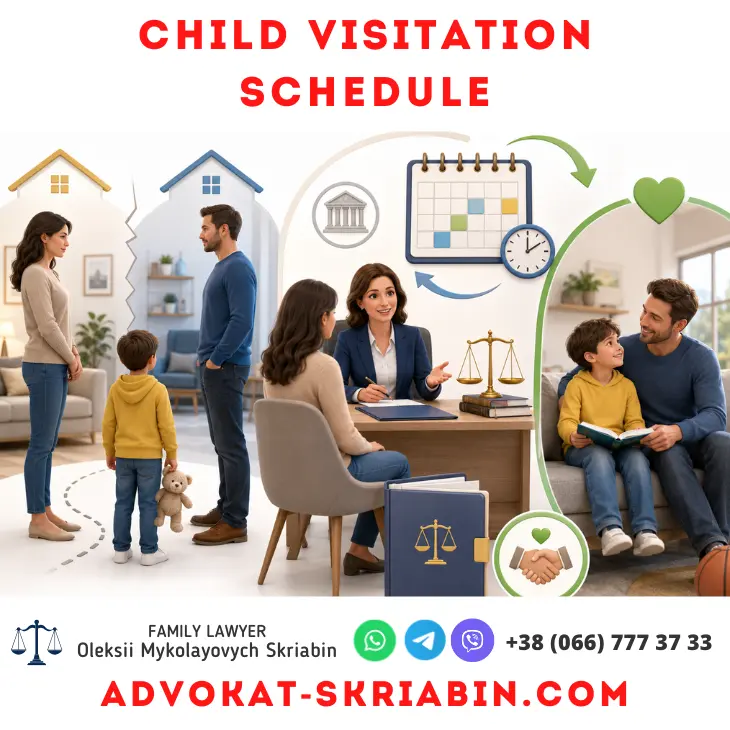

Child Visitation Schedule in Ukraine After Divorce
Divorce changes the family structure, but it does not end the relationship between a parent and a child. In most cases, both parents retain the right and responsibility to participate in the child’s life, upbringing, education, and emotional development. Establishing a clear child visitation schedule helps avoid conflicts and provides stability for the child.
For many Ukrainian families, especially when one parent lives abroad or serves in the military, maintaining regular communication becomes a practical and legal challenge. A properly established child visitation schedule after divorce creates predictable rules and protects the interests of both the child and the parents.
The online divorce service regularly assists parents who need legal guidance regarding contact arrangements after divorce. In many situations, addressing these issues early helps prevent lengthy disputes and emotional stress for children.
What Is a Child Visitation Schedule and Why Is It Important
A child visitation schedule is a structured arrangement that determines when, where, and how a parent communicates and spends time with a child after separation or divorce. It may include personal meetings, holidays, school vacations, online communication, and other forms of contact.
The primary purpose of a visitation schedule is not to protect parental interests alone. Its main objective is to ensure that the child maintains meaningful relationships with both parents whenever such contact serves the child’s best interests.
Without a clear arrangement, misunderstandings often arise. One parent may expect more frequent communication, while the other may impose restrictions. A written schedule helps prevent disputes and creates clear expectations for everyone involved.
A properly drafted parenting time schedule also reduces uncertainty for the child. Children adapt better when they know when they will see each parent and can maintain consistent emotional connections with both sides of the family.
Parental Rights to Contact and Communication with a Child
Ukrainian family law on the official legislative portal Family Code of Ukraine recognizes that both parents generally have equal rights and responsibilities concerning their children, regardless of whether they live together or separately.
Parental rights to contact with a child include the ability to communicate, participate in education, attend important events, receive information about health and development, and maintain emotional relationships with the child.
The parent with whom the child permanently resides cannot arbitrarily deprive the other parent of communication opportunities. Likewise, the parent living separately must exercise these rights responsibly and in a manner that respects the child’s well-being.
Courts and guardianship authorities evaluate each situation individually. Factors such as the child’s age, health, emotional attachment, educational needs, and overall safety may influence the scope of contact arrangements.
Child Visitation Schedule After Divorce: What Does the Law Say
After divorce, the legal relationship between parent and child remains intact. The dissolution of marriage does not terminate parental rights or obligations. Ukrainian legislation generally supports the child’s right to maintain contact with both parents. If parents cannot agree on communication arrangements, the dispute may be resolved through guardianship authorities or court proceedings.
The law focuses primarily on the child’s best interests. Therefore, visitation schedules are not established solely according to parental preferences. Courts consider practical circumstances, including residence, travel distance, school obligations, and the child’s daily routine. When determining a child visitation schedule after divorce, authorities seek a balance between preserving family relationships and ensuring stability in the child’s life.
How to Establish a Child Visitation Schedule by Agreement
The simplest and least stressful approach is to reach a voluntary agreement. Parents who communicate constructively can establish a child visitation schedule without litigation. An agreement may define regular meetings, holiday arrangements, vacation periods, transportation responsibilities, communication methods, and procedures for resolving future disagreements.
Written agreements are often preferable because they reduce misunderstandings and provide clear evidence of the parties’ intentions. Although informal arrangements are possible, written documentation typically offers greater legal certainty. Parents should focus on practical solutions rather than personal conflicts. The more detailed the agreement, the easier it becomes to avoid future disputes regarding communication with the child.
Parenting Plan and Voluntary Arrangements Between Parents
A parenting plan after divorce is a comprehensive document that regulates parental involvement in a child’s life. It often includes more than a simple visitation schedule. Such a plan may address education, healthcare decisions, extracurricular activities, holiday schedules, communication methods, and procedures for making important decisions affecting the child.
A well-prepared parenting plan after divorce provides flexibility while preserving stability. It allows parents to coordinate responsibilities and maintain consistent involvement in the child’s upbringing. Even when relationships between former spouses are strained, a structured parenting plan can significantly reduce future conflicts and promote cooperation focused on the child’s interests.
When Does the Guardianship Authority Determine Contact with a Child
When parents cannot reach an agreement, the guardianship authority may become involved. Its role is to evaluate circumstances and propose solutions that serve the child’s welfare. The authority may examine living conditions, interview parents, collect information about the child’s needs, and assess practical factors affecting communication arrangements.
Although guardianship recommendations are important, they do not always resolve disputes completely. In many cases, one parent may disagree with the proposed arrangement and seek judicial review. Nevertheless, participation by guardianship authorities often provides valuable evidence and professional assessments that may later be considered by the court.
How to Establish a Child Visitation Schedule Through Court
When voluntary negotiations fail, parents may establish a child visitation schedule through court proceedings. The court examines evidence presented by both parties and determines how communication should occur. The final decision may regulate visitation frequency, duration, location, holiday arrangements, online communication, and other relevant matters.
Each case is unique. There is no universal schedule applicable to all families because every child has different needs and circumstances. If a parent chooses legal representation, it is important to remember: A lawyer represents the client’s interests on the basis of a legal assistance agreement, which may be concluded online. A power of attorney is not required for this purpose.
What Documents Are Required for a Court Claim
A court claim regarding child visitation rights after divorce should be supported by documents that help demonstrate the circumstances of the case and the parent’s involvement in the child’s life. Typically, the court will expect documents confirming the identity of the parties, the child’s birth information, the divorce status if applicable, and evidence showing previous communication with the child. Depending on the circumstances, additional materials may be useful, including correspondence, photographs, travel records, school information, medical documents, or evidence showing obstacles created by the other parent.
The purpose of these documents is not merely to satisfy procedural requirements. They help the court understand the family situation and determine what arrangement best serves the child’s interests. Parents should ensure that all submitted materials are accurate, organized, and relevant to the dispute. Well-prepared evidence often contributes to a more efficient resolution of the case.
How Does a Court Determine a Child Visitation Schedule
When deciding a child visitation schedule through court, judges evaluate numerous factors rather than applying a standard formula. The court usually considers the child’s age, emotional attachment to each parent, educational schedule, health condition, place of residence, and the ability of each parent to support the child’s development. The willingness of parents to cooperate may also influence the final decision.
The child’s opinion may be considered when appropriate, depending on maturity and circumstances. However, the court does not simply follow the wishes of either parent or even the child. The primary focus remains the child’s overall welfare. As a result, the parenting time schedule established by the court is intended to create stability, preserve family relationships, and minimize future conflicts.
Can the Court Order Online Communication and Video Calls
Modern family life often involves parents living in different cities or countries. Because of this reality, courts increasingly recognize the importance of online communication. A court may include video calls, online meetings, messaging applications, and other digital communication methods within a child visitation schedule in Ukraine. Such arrangements can be especially important when physical meetings are limited by distance, military service, work obligations, or international residence.
Online communication does not usually replace personal meetings entirely. Instead, it supplements direct contact and helps maintain a meaningful relationship between parent and child. In many international family situations, virtual communication becomes an essential component of child communication and visitation rights in Ukraine. When the parent cannot be physically present, online participation of a lawyer in family proceedings may also help organize legal steps remotely.
What to Do If the Other Parent Prevents Contact with the Child
Unfortunately, disputes sometimes escalate to situations where one parent actively interferes with communication between the child and the other parent. If informal discussions fail, it is important to document incidents that demonstrate obstruction. Messages, correspondence, witness statements, and other evidence may later become important in administrative or judicial proceedings.
Parents should avoid emotional confrontations that may negatively affect the child. Instead, they should focus on lawful methods of protecting parental rights to contact with a child, including removing obstacles to communication with the child when voluntary contact is repeatedly blocked. When communication problems persist, professional legal assistance may help identify the most effective strategy for restoring contact and protecting the child’s interests.
Enforcement of a Court Decision on Child Visitation
Obtaining a favorable judgment is only one stage of the process. In some cases, difficulties arise during enforcement. If a parent refuses to comply with a court-approved visitation arrangement, enforcement procedures may be initiated. Authorities responsible for enforcement may take measures aimed at ensuring compliance with the court’s decision.
Repeated violations can create legal consequences for the non-compliant parent. Courts generally expect both parties to respect judicial decisions and act in good faith. Effective enforcement protects not only parental rights but also the child’s right to maintain relationships with both parents whenever such relationships are beneficial and safe.
How to Modify an Existing Child Visitation Schedule
Family circumstances often change over time. A schedule that was appropriate several years ago may no longer meet the child’s needs. Modification may become necessary due to relocation, changes in school schedules, health issues, employment changes, military service, or international travel requirements. Parents may voluntarily agree on adjustments or seek official modification when consensus cannot be reached.
Courts generally consider whether new circumstances justify altering the existing arrangement and whether proposed changes serve the child’s best interests. A flexible yet structured approach helps ensure that the parenting plan after divorce continues to reflect the realities of the child’s life. In related family disputes, determining the child’s place of residence may also influence how future communication with each parent is organized.
Child Visitation Rights for Military Personnel and Parents Living Abroad
Many Ukrainian families face unique challenges because one parent serves in the military or resides outside Ukraine. Military service may limit opportunities for traditional visitation, but it does not automatically eliminate child visitation rights after divorce. Courts and authorities may consider alternative communication methods, flexible schedules, and special arrangements during leave periods.
Similarly, parents living abroad retain the ability to maintain meaningful relationships with their children. International residence may require greater reliance on online communication, extended holiday visits, and carefully coordinated travel arrangements.
The goal remains the same: preserving the child’s relationship with both parents despite geographical or professional obstacles. The online divorce service frequently receives inquiries from Ukrainians living abroad who seek assistance in establishing or protecting contact with their children while residing outside the country. In such cases, legal planning may also be connected with divorce with a spouse abroad or with situations where one parent needs to resolve family matters from another country.
Why Hire a Lawyer for Child Visitation and Parenting Disputes
Parenting disputes are often emotionally challenging because they involve family relationships rather than purely legal issues. An experienced lawyer can help evaluate evidence, prepare legal documents, communicate with authorities, represent parental interests during negotiations, and protect rights throughout court proceedings.
Professional assistance may also reduce stress by providing clarity regarding legal procedures and realistic expectations. This is especially valuable when disputes involve international elements, military service, relocation, or persistent obstruction of communication.
A lawyer represents the client’s interests on the basis of a legal assistance agreement, which may be concluded online. A power of attorney is not required for this purpose. If the dispute requires broader legal assessment, a family lawyer consultation can help determine the safest procedural strategy.
Step-by-Step Guide
- Assess the current communication situation and determine whether cooperation with the other parent is possible.
- Attempt to negotiate and establish a child visitation schedule voluntarily.
- Prepare a parenting plan after divorce that clearly describes meetings, holidays, communication methods, and responsibilities.
- If an agreement cannot be reached, contact the guardianship authority for assistance and recommendations.
- Collect documents and evidence demonstrating your involvement in the child’s life and any obstacles to communication.
- File a claim seeking to establish a child visitation schedule through court if necessary. When the dispute is connected with divorce proceedings, divorce with children in Ukraine may require additional attention to the child’s interests and future parenting arrangements.
- Follow the approved arrangement and seek modification if significant circumstances change in the future.
Phone / Viber / WhatsApp / Telegram: +380667773733
Email: skriabinadvokat@gmail.com