
- What Is Legalization of Documents for the Czech Republic
- Do Ukrainian Documents Need an Apostille for the Czech Republic
- Which Documents Can Be Legalized for Use in the Czech Republic
- Apostille for the Czech Republic: Rules and Requirements
- Certified Translation of Documents into Czech Language
- Legalization of Birth, Marriage and Divorce Certificates for the Czech Republic
- Apostille for Diplomas, Educational Documents and Academic Records
- Legalization of Criminal Record Certificates for the Czech Republic
- Court Decisions and Legal Documents for Use in the Czech Republic
- How to Prepare Documents for Work, Residence and Study in the Czech Republic
- Step-by-Step Process of Legalizing Documents for the Czech Republic
- Can You Obtain an Apostille for the Czech Republic Remotely
- Processing Times and Costs of Legalization for the Czech Republic
- Common Mistakes When Preparing Documents for the Czech Republic
- Legal Assistance with Document Legalization for the Czech Republic
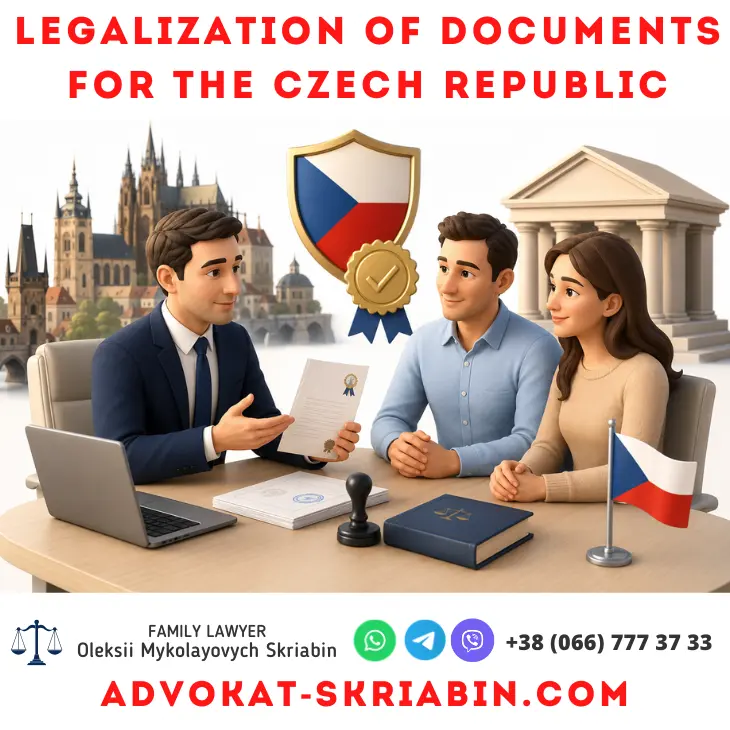
What Is Legalization of Documents for the Czech Republic
Legalization of documents for the Czech Republic is the process that makes a Ukrainian official document suitable for use before Czech authorities. In practice, this usually means confirming the authenticity of the document by apostille and then preparing a certified translation into Czech, unless the receiving authority accepts another format.
An apostille does not confirm that every fact written in the document is legally correct in the Czech Republic. It confirms the authenticity of the signature, seal and authority of the Ukrainian official who issued or certified the document. This distinction is important because people often expect an apostille to “approve” the whole document, while in reality it confirms its official origin.
For Ukrainian citizens, legalization of documents through a lawyer may be useful when several documents must be prepared together: civil status certificates, court decisions, educational records, criminal record certificates and notarized copies. A lawyer can check whether the document is suitable for apostille, whether a duplicate is needed and whether the translation must be arranged before or after apostille.
In many cases, legalization of documents online for the Czech Republic is possible as a coordinated remote service: the client sends scans, receives a document checklist, confirms the purpose of use, and the lawyer organizes the necessary actions in Ukraine. Original documents may still be required for apostille, but consultation, document review and preparation can often be handled remotely.
Do Ukrainian Documents Need an Apostille for the Czech Republic
Ukrainian documents usually need an apostille for the Czech Republic because both Ukraine and the Czech Republic participate in the apostille system. This simplified procedure replaces full consular legalization for many official documents intended for use between participating countries.
If a Ukrainian birth certificate, marriage certificate, divorce certificate, court decision, diploma or criminal record certificate is submitted to a Czech authority, the authority will often expect the document to be apostilled and translated into Czech. However, the final requirement depends on the type of procedure and the institution receiving the document.
Apostille and translation for the Czech Republic should be planned together. Sometimes the apostille is placed on the original document, and then the entire document with apostille is translated. In other situations, a notarized copy or translation may require separate certification depending on the request of the Czech institution.
The main practical rule is simple: before submitting Ukrainian documents in the Czech Republic, it is better to check the requirements in advance. A document that looks correct in Ukraine may be rejected abroad if the apostille is missing, the translation is not certified properly, or the document was issued in a format that the receiving authority does not accept.
Which Documents Can Be Legalized for Use in the Czech Republic
Different categories of Ukrainian documents can be prepared for use in the Czech Republic. The most common are civil status documents, educational documents, court documents, notarial documents, extracts from registers, criminal record certificates and documents connected with family status or migration procedures.
Legalization of Ukrainian documents for the Czech Republic often includes birth certificates, marriage certificates, divorce certificates, name change documents, death certificates, extracts from the civil status register and court decisions on divorce or recognition of legal facts. These documents are frequently required for residence, family reunification, marriage, employment, study, inheritance or administrative procedures.
Educational documents may include diplomas, diploma supplements, academic transcripts, certificates from educational institutions and archive confirmations. For study, employment or recognition of qualifications, Czech institutions may require apostille for diplomas and certified translation into Czech language.
Court decisions and legal documents require special attention. A divorce judgment, decision on establishing a legal fact or other court document may need to be final and enforceable before it can be used abroad. If the decision has not entered into legal force or lacks the necessary court mark, apostille documents for the Czech Republic may be refused or later rejected by the Czech authority.
Apostille for the Czech Republic: Rules and Requirements
Apostille for the Czech Republic is issued by the competent authority of the country where the document was issued. For Ukrainian documents, the apostille must be obtained in Ukraine from the competent Ukrainian authority depending on the document type.
For example, educational documents are usually handled through the competent authority responsible for education documents. Civil status documents, notarial documents and court-related documents may fall under other Ukrainian competent authorities. General information about apostille, civil status documents and registration procedures may be checked through official Ukrainian justice services.
The apostille confirms the official origin of the document. It does not replace translation, does not correct errors in names or dates, and does not make an expired or unsuitable document valid for every purpose. If the document contains mistakes, outdated personal data or inconsistent spelling, those issues should be corrected before apostille and translation.
Apostille documents for the Czech Republic must be prepared with the future procedure in mind. For residence, work, marriage, study or court use, Czech authorities may have different expectations regarding document age, certified translation, original form or additional confirmations.
Certified Translation of Documents into Czech Language
Certified translation for the Czech Republic is usually required when Ukrainian documents are submitted in Czech administrative, migration, educational or court procedures. If the document is in Ukrainian, it normally has to be translated into Czech so that the receiving authority can properly assess it.
Translation of documents into Czech language should cover the full content of the document, including stamps, seals, signatures, apostille text and official notes. A partial translation may be rejected because the authority must understand not only the main certificate but also the authentication attached to it.
The order of actions matters. In many cases, the apostille is obtained first, and then the document together with the apostille is translated. If translation is done too early, the apostille page may remain untranslated, and the client may need to order an additional translation.
A certified translation should also preserve names, dates and official terms carefully. Differences in transliteration between Ukrainian, English and Czech versions can create problems, especially in residence, marriage, education and family law procedures. If the document package concerns family status, it is useful to check marriage documents for Ukrainians abroad before submitting papers to a foreign authority.
Legalization of Birth, Marriage and Divorce Certificates for the Czech Republic
Birth, marriage and divorce certificates are among the most common documents that Ukrainian citizens prepare for the Czech Republic. They may be needed for residence permits, family reunification, marriage registration, change of surname, confirmation of family status, inheritance or other official procedures.
Legalization of documents for the Czech Republic in this category usually begins with checking whether the client has a valid original or whether a duplicate certificate should be obtained. Older documents, damaged documents or documents with spelling differences may require replacement before apostille.
Divorce documents deserve special attention. Depending on how the divorce was completed in Ukraine, a person may need a divorce certificate, a court decision on divorce, a confirmation that the court decision entered into legal force, or several documents together. In practice, the correct package often depends on whether the person needs proof of divorce after a Ukrainian court decision or another civil status document.
In the middle of the process, the Service for Online Divorce may be helpful when a Ukrainian citizen needs divorce-related documents prepared remotely, including obtaining the necessary Ukrainian document, arranging apostille and organizing translation for use in the Czech Republic.
Apostille for Diplomas, Educational Documents and Academic Records
Apostille for diplomas, educational documents and academic records is often required for study, employment, recognition of qualifications or professional registration in the Czech Republic. This category includes diplomas, diploma supplements, academic transcripts, certificates from universities and other education-related documents.
Educational documents are sensitive because Czech institutions may check not only apostille and translation, but also the type of document, issuing institution, study period, qualification and completeness of academic records. If the package is incomplete, the institution may request additional confirmations.
Certified translation for the Czech Republic should accurately reflect the names of educational institutions, specialties, qualifications and grades. Incorrect translation of a qualification or academic title can create misunderstanding during admission, employment or recognition procedures.
Before apostille and translation, it is useful to clarify what exactly the Czech institution requires: diploma only, diploma with supplement, transcript, archive certificate, curriculum or confirmation from the educational institution. Preparing only one document may be insufficient if the procedure requires a complete academic package.
Legalization of Criminal Record Certificates for the Czech Republic
A criminal record certificate may be required for residence, employment, professional licensing, citizenship-related procedures, family matters or other administrative processes in the Czech Republic. For Ukrainian citizens, this document often needs apostille and certified translation into Czech.
Legalization of Ukrainian documents for the Czech Republic in this category depends on the format of the certificate and the requirements of the receiving authority. Some institutions may accept electronic verification, while others may require a paper document with apostille and certified translation.
It is important to check whether the certificate must be recent. Many authorities apply their own validity expectations to criminal record certificates, even if the document itself does not contain a long formal validity period. Therefore, ordering the certificate too early may create a risk that it becomes unsuitable by the time of submission.
Apostille and translation for the Czech Republic should be arranged only after the correct format of the criminal record certificate is confirmed. If the document is issued in a form that cannot be apostilled or is not accepted by the Czech authority, the client may lose time and need to repeat the process.
Court Decisions and Legal Documents for Use in the Czech Republic
Court decisions and legal documents require careful preparation because Czech authorities may need proof not only that the document exists, but also that it is final, valid and suitable for the intended legal purpose. This is especially important for divorce judgments, decisions on establishing legal facts, parental matters, inheritance issues and other family-related cases.
A Ukrainian court decision for use in the Czech Republic may need a mark confirming that it entered into legal force. In some cases, additional court certificates or copies certified by the court may be required. Without these elements, apostille may not solve the practical problem because the receiving authority may still consider the document incomplete.
Legalization of documents through a lawyer is especially useful for court decisions because a lawyer can check the procedural status of the decision and identify whether additional documents are needed. This helps avoid a situation where a person translates and apostilles a document that later turns out to be insufficient. For divorce cases, it is also important to understand the next steps after receiving a Ukrainian divorce judgment before preparing the document for foreign use.
If representation is needed, the following rule is important: The lawyer represents the client’s interests on the basis of a legal assistance agreement, which may be concluded online. A power of attorney is not required for this.
How to Prepare Documents for Work, Residence and Study in the Czech Republic
Documents for work, residence and study in the Czech Republic should be prepared according to the specific purpose of submission. The package for a residence procedure may differ from the package required by an employer, university or professional licensing body.
For work, a person may need a diploma, criminal record certificate, family status documents or other confirmations. For residence, Czech authorities may request civil status documents, documents concerning children, proof of marriage or divorce, and other personal documents. For study, educational documents and academic records are usually central.
Translation of documents into Czech language should be consistent across the entire package. If a person’s name is translated or transliterated differently in several documents, this may create additional questions. It is better to identify such differences before submission and, where necessary, prepare explanatory documents or corrected records.
Legal support for document legalization in the Czech Republic does not mean replacing the Czech authority’s decision. It means preparing the Ukrainian side of the document package correctly: checking the document, obtaining apostille, arranging certified translation and reducing avoidable risks before submission.
Step-by-Step Process of Legalizing Documents for the Czech Republic
First, define the exact purpose of use in the Czech Republic: residence, work, study, marriage, divorce confirmation, family reunification, court procedure or another official matter. The purpose determines which documents are needed and how they should be prepared.
Second, check the original Ukrainian document. It must be readable, complete and suitable for apostille. If the document is old, damaged or contains errors, it may be necessary to obtain a new duplicate or additional confirmation before starting legalization.
Third, determine the competent authority for apostille in Ukraine. Different document types may be processed by different authorities, so choosing the wrong route can delay the process.
Fourth, obtain apostille on the required document or document package. The apostille should be placed correctly and should correspond to the document that will be submitted in the Czech Republic.
Fifth, arrange certified translation into Czech. The translation should include the document itself, seals, signatures, official notes and the apostille.
Sixth, check the final package before submission. The names, dates, document numbers and translations should be consistent and easy for the Czech authority to verify.
Seventh, submit the documents to the receiving authority or send them to the person who will use them in the Czech Republic. If the authority requests clarification, it is better to respond with legally accurate explanations rather than informal comments.
Can You Obtain an Apostille for the Czech Republic Remotely
Legalization of documents online for the Czech Republic is often possible in the sense that consultation, document analysis, preparation of the package, coordination with the client and many organizational steps can be handled remotely. This is especially useful for Ukrainian citizens living abroad.
However, apostille is connected with official documents, and original documents may be required. Therefore, remote support usually means that the client sends the necessary documents or authorizes the legal team to obtain duplicates where legally possible, while the lawyer coordinates the process in Ukraine.
Remote work is particularly convenient when a person cannot travel to Ukraine, lives in the Czech Republic or another country, or needs several Ukrainian documents prepared at the same time. It can also help when the client does not know which authority should issue the apostille. If the case also concerns family status in Czech jurisdiction, it may be useful to review divorce issues for Ukrainians connected with the Czech Republic before preparing the final package.
The main benefit of remote legal support is not only convenience. It also helps avoid repeated trips, incorrect translations, missing apostille pages and submission of documents in a form that the Czech institution may not accept.
Processing Times and Costs of Legalization for the Czech Republic
Processing times and costs depend on the document type, the competent authority, the need to obtain duplicates, translation requirements, delivery method and urgency. It is not correct to estimate the full price without checking the exact document package.
Some documents can be prepared relatively quickly, while others require additional steps, such as obtaining a duplicate certificate, court copy, confirmation of legal force, archive document or educational record. Translation also adds time, especially if several documents must be translated together.
The cost may include official fees, document retrieval, apostille, certified translation, legal review, courier delivery and additional services if the client is abroad. Current official fees should always be checked at the time of application because they may change.
For a practical estimate, the client should provide scans or clear photos of the documents and explain where they will be submitted in the Czech Republic. This allows the lawyer to assess the route, identify risks and explain the approximate scope of work before the client sends originals.
Common Mistakes When Preparing Documents for the Czech Republic
One common mistake is ordering translation before apostille, and then discovering that the apostille itself also needs to be translated. This can lead to additional costs and delays. Another mistake is assuming that any Ukrainian document can be apostilled in its current form. If the document is damaged, incomplete, issued by an institution that requires special verification or lacks necessary marks, it may need preparation before apostille.
People also often ignore differences in spelling of names. A surname may appear differently in Ukrainian, English and Czech contexts. If these differences are not addressed, the receiving authority may request explanations or additional documents.
A further mistake is preparing only one document when the Czech authority expects a complete package. For example, a divorce case may require not only a judgment but also confirmation that it entered into legal force, while an education procedure may require not only a diploma but also a supplement or transcript.
Legal Assistance with Document Legalization for the Czech Republic
Legal assistance with document legalization in the Czech Republic is useful when the client wants to prepare documents correctly from the first attempt. A lawyer can review the purpose of use, check the documents, explain the apostille route, coordinate translation and advise on possible risks.
This support is especially important for Ukrainian citizens abroad, people preparing documents for residence or study, and clients who need court or divorce documents for Czech authorities. In such cases, a small mistake in the package can delay the entire procedure.
Legalization of documents through a lawyer also helps when several documents must be prepared at once and each document has a different route. Civil status certificates, diplomas, court decisions and criminal record certificates may require different checks before apostille and translation. When a client is abroad, remote participation of a family lawyer can help organize procedural actions without unnecessary travel.
At the final stage, the Service for Online Divorce may assist clients who need Ukrainian divorce-related documents, apostille, certified translation and remote legal support connected with their use in the Czech Republic. You can request consultation, send document scans for review, or ask for help with preparing the correct document package.
Useful materials on the site advokat-skriabin.com
- Establishing the fact of independent upbringing of a child
- Divorce lawyer
- Legalization and apostille of Ukrainian documents for use abroad
- Recognition in Ukraine of a foreign court decision on divorce
- Family lawyer consultation
- Alimony lawyer
- Deprivation of parental rights
- Determining the child’s place of residence
- Removing obstacles in communicating with the child
- ✅ Obtaining a court decision