
- What Is a Fake Divorce and When Is It Considered Sham
- How to Distinguish a Fake Divorce from a Genuine Divorce
- Why Do Spouses Enter into a Fake Divorce
- Legal Grounds for Recognition of a Fake Divorce in Ukraine
- Who Can Challenge a Fake Divorce in Court
- How to Prove a Fake Divorce: Evidence and Documentation
- Continued Cohabitation After Divorce as Proof of Sham Divorce
- Court Procedure for Recognition of a Fake Divorce
- What Are the Legal Consequences of a Fake Divorce
- Fake Divorce for Hiding Assets or Avoiding Debts
- Fake Divorce and Property Division Disputes
- Can a Fake Divorce Affect Inheritance Rights
- Court Practice in Fake Divorce Cases in Ukraine
- Can a Divorce Be Cancelled After It Has Been Finalized
- Legal Assistance in Challenging a Fake Divorce
- Step-by-Step Guide: How to Challenge a Fake Divorce
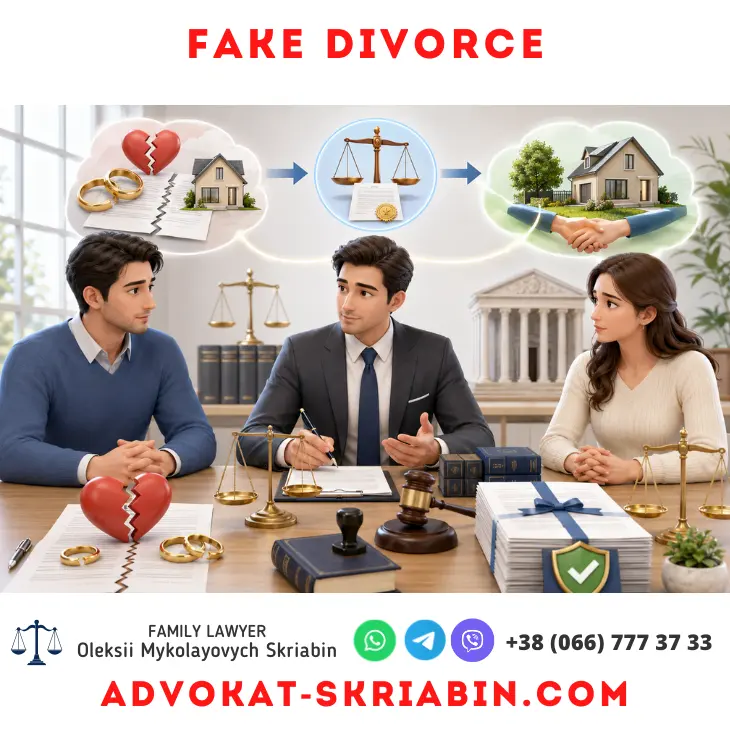

What Is a Fake Divorce and When Is It Considered Sham
A fake divorce is generally understood as a formal termination of marriage where the spouses do not genuinely intend to end their family relationship. Although the divorce is officially registered or confirmed by a court decision on divorce, the parties may continue living together as a family, sharing finances, managing property jointly, and presenting themselves to others as husband and wife.
The key issue is not whether the divorce documents were legally issued, but whether there was a real intention to terminate marital relations. When a divorce is used merely as a legal tool to obtain some advantage while preserving the actual family relationship, questions regarding a sham divorce may arise.
In practice, disputes concerning a fake divorce in Ukraine often appear when creditors, heirs, former spouses, or other interested parties believe that the divorce was arranged to avoid legal obligations or gain an unfair advantage. Courts evaluate not only documents but also the actual conduct of the parties after the divorce.
The concept of a sham legal action is closely connected to the principle that legal procedures should reflect genuine intentions. If the facts show that the parties never intended to separate, the issue of recognition of a fake divorce may become relevant. Analysis of similar disputes can often be found in the Unified State Register of Court Decisions..
How to Distinguish a Fake Divorce from a Genuine Divorce
Not every divorce followed by reconciliation is a fake divorce. Former spouses may legitimately end their marriage and later decide to rebuild their relationship. Such circumstances do not automatically prove bad faith or a lack of intention to separate.
The distinction usually depends on the circumstances existing at the time of the divorce. A genuine divorce is typically accompanied by a real breakdown of family relations, separate decision-making, independent financial management, and an intention to end marital obligations. Similar principles are discussed in matters concerning divorce in Ukraine..
A sham divorce, by contrast, may involve a situation where the spouses never truly separate. They may continue sharing the same residence, using common bank accounts, purchasing assets together, and presenting themselves publicly as a married couple immediately after the divorce becomes effective.
Courts usually examine the entire picture rather than a single fact. Continued cohabitation alone may not be sufficient, but when combined with other circumstances, it may become important evidence of a fake divorce. The assessment is always individual and depends on the specific facts of the case.
Why Do Spouses Enter into a Fake Divorce
The reasons behind a fake divorce can vary significantly. In some situations, spouses believe that a formal divorce may help protect family assets from creditors or enforcement proceedings. In others, they may attempt to obtain certain benefits, avoid financial obligations, or influence future property disputes.
Another common motive involves inheritance planning. Some individuals mistakenly assume that a formal divorce can change the legal position of potential heirs while allowing the former spouses to continue living together as before. Such arrangements often create future legal conflicts.
Property-related concerns also play a major role. A couple may believe that dissolving the marriage will make it easier to transfer ownership, shield assets, or complicate claims by third parties. However, if the divorce is later questioned, those transactions may attract close judicial scrutiny, especially where disputes over division of property of spouses arise.
Some cases involve international elements. Ukrainians living abroad may initiate divorce proceedings for administrative or practical reasons while continuing their family relationship. Although every situation is different, courts generally focus on the real intentions of the parties rather than the formal explanation provided after the fact. Such situations may overlap with issues discussed in divorce abroad and disputes regarding establishing the fact of living together as one family without registering a marriage.
Legal Grounds for Recognition of a Fake Divorce in Ukraine
The issue of recognition of a fake divorce is closely connected with the principle that legal actions must reflect the genuine intention of the parties. Ukrainian courts generally assess not only the formal legality of the divorce procedure but also whether the spouses truly intended to terminate their family relationship.
When a person seeks recognition that a divorce was fictitious, the court usually examines the circumstances before, during, and after the dissolution of marriage. Particular attention may be given to continued family life, financial cooperation, common residence, and the overall behavior of the former spouses.
A court will not automatically conclude that a divorce is fake merely because former spouses maintained friendly relations or occasionally interacted after the divorce. The decisive issue is whether the parties actually intended to end their marriage or whether the divorce was only a formal instrument used to obtain another legal result.
In many cases, the question arises within broader disputes involving inheritance, debt recovery, property ownership, or creditor protection. The existence of a sham divorce is often one element of a larger legal conflict rather than a separate issue standing alone.
For Ukrainians living abroad, additional complexities may arise when the divorce was registered in another jurisdiction or when property and legal interests are located in different countries. In such cases, courts may evaluate both Ukrainian law and relevant international circumstances.
The online divorce service regularly encounters situations where clients discover that a previous divorce may have been used to create legal consequences that were never genuinely intended by the spouses. Careful legal analysis is essential before initiating court proceedings.
Who Can Challenge a Fake Divorce in Court
A common misconception is that only former spouses can challenge a divorce. In reality, a wider range of individuals may have a legitimate interest in proving that a divorce was fictitious. The first category includes one of the former spouses who believes that the divorce was obtained under circumstances that do not reflect the true intentions of the parties. Such cases may arise when property, inheritance, or family rights become disputed years later.
Creditors may also have an interest in proving a fake divorce in Ukraine. If a debtor transferred assets, restructured ownership, or attempted to avoid financial obligations through a formal divorce while continuing family life, creditors may seek judicial protection of their rights.
Potential heirs frequently become involved in these disputes. A person expecting to inherit property may argue that a divorce was fictitious and should not be relied upon to alter inheritance rights or property arrangements created during the marriage.
In some situations, business partners, co-owners, or other persons whose rights are directly affected may also seek judicial review of the circumstances surrounding a divorce. The key factor is whether the person has a legally protected interest that may be harmed by the consequences of the alleged sham divorce.
The court will normally require the claimant to demonstrate a direct connection between the disputed divorce and the rights being asserted. Abstract disagreement with the former spouses’ behavior is generally insufficient.
How to Prove a Fake Divorce: Evidence and Documentation
The success of any case involving how to prove a fake divorce depends largely on evidence. Courts make decisions based on proven facts rather than assumptions, suspicions, or personal beliefs.
A person seeking recognition of a sham divorce must demonstrate that the spouses did not genuinely intend to end their marital relationship. This often requires showing a consistent pattern of behavior that contradicts the idea of a real separation.
The most persuasive evidence of a fake divorce usually consists of multiple sources that support each other. Courts tend to evaluate the totality of circumstances rather than relying on a single document or witness statement.
Examples of evidence that may be relevant include:
- Documents confirming continued residence at the same address.
- Utility payments made jointly after divorce.
- Evidence of joint property management.
- Financial transactions showing continued economic cooperation.
- Insurance, banking, or contractual documents.
- Testimony from witnesses familiar with the family situation.
- Correspondence demonstrating ongoing family relations.
- Photographs, travel records, or other materials confirming continued cohabitation.
Digital evidence has become increasingly important. Messages, emails, social media activity, and electronic records may help establish whether former spouses continued functioning as a family after their formal divorce.
At the same time, courts generally distinguish between ordinary communication and genuine family life. Occasional contact, especially when children are involved, does not necessarily indicate a fake divorce. The quality of evidence is usually more important than the quantity. A smaller number of reliable documents may carry greater weight than a large volume of weak or irrelevant materials.
Continued Cohabitation After Divorce as Proof of Sham Divorce
One of the most frequently discussed indicators of a sham divorce is continued cohabitation after the marriage has officially ended. However, continued residence in the same property does not automatically prove that the divorce was fictitious.
Former spouses may continue sharing accommodation for financial, practical, or family reasons. Economic difficulties, childcare responsibilities, or housing shortages may explain why people remain under the same roof after divorce.
For this reason, courts generally look beyond the simple fact of cohabitation. They examine whether the former spouses continued living as a family in the broader sense of the term. Relevant circumstances may include shared expenses, common decision-making, joint ownership management, mutual financial support, participation in family events, and the way the parties presented themselves to others.
A court may also consider whether the spouses maintained separate households or whether they continued functioning as a unified family unit. The answer often depends on the cumulative assessment of numerous facts rather than a single circumstance.
Where continued cohabitation is combined with joint financial activity and evidence of a preserved family relationship, it may become significant evidence of a fake divorce. Conversely, cohabitation without additional indicators may not be sufficient to support a claim.
For individuals seeking to challenge a divorce in court, understanding this distinction is extremely important. Courts focus on substance rather than appearance and require convincing proof that the family relationship never truly ended.
Court Procedure for Recognition of a Fake Divorce
The court procedure usually begins with the preparation of a claim explaining why the divorce should be regarded as fictitious and how the claimant’s rights have been affected. The statement of claim must clearly identify the factual circumstances relied upon, describe the legal interest being protected, and specify the evidence supporting the allegations. Careful preparation at this stage often influences the overall strength of the case.
After proceedings are initiated, the court examines written evidence, hears witness testimony where appropriate, and evaluates the conduct of the parties. Each side has an opportunity to present arguments and challenge the evidence submitted by the opposing party.
Because cases involving recognition of a fake divorce often concern complex factual issues, the evidentiary stage may become the most important part of the proceedings. Courts frequently analyze long periods of family behavior rather than isolated events.
Where representation is required, it is important to remember that: A lawyer represents the client’s interests on the basis of a legal assistance agreement, which may be concluded online. A power of attorney is not required for this purpose. For Ukrainians residing abroad, participation in legal proceedings may often be organized remotely, depending on the circumstances of the case and applicable procedural rules.
What Are the Legal Consequences of a Fake Divorce
The legal consequences of a fake divorce can extend far beyond the relationship between the former spouses. Once a court determines that a divorce was merely formal and did not reflect a genuine intention to terminate family relations, various legal rights and obligations may be affected.
Many disputes arise because third parties relied on the apparent existence of a valid divorce. Creditors, heirs, business partners, and other interested persons may have made decisions based on the belief that the marriage had truly ended. If that assumption is later challenged, significant legal complications may follow.
The consequences depend on the specific circumstances of each case. Property transactions, inheritance rights, debt obligations, and financial arrangements may all become subject to judicial review. Courts often examine whether the divorce was used to obtain an unfair advantage or circumvent legal responsibilities.
Importantly, recognition that a divorce was fictitious does not automatically resolve every related dispute. Additional court proceedings may be necessary to determine ownership rights, financial obligations, or the validity of transactions completed after the divorce. For this reason, individuals involved in potential fake divorce in Ukraine disputes should assess not only the divorce itself but also all legal actions that followed it.
Fake Divorce for Hiding Assets or Avoiding Debts
One of the most common allegations in cases involving a sham divorce is that the spouses sought to protect assets from creditors or enforcement measures. In practice, a couple may formally dissolve their marriage while transferring property to one spouse or restructuring ownership arrangements. The expectation is often that creditors will face greater difficulty pursuing assets once the divorce has been finalized.
However, courts generally look beyond formal documents and examine the real economic relationship between the parties. If evidence demonstrates that the spouses continued operating as a family unit and that the divorce served only as a mechanism for asset protection, the arrangement may receive close judicial scrutiny.
Creditors frequently attempt to establish that a fake divorce was part of a broader effort to evade financial obligations. In such cases, the court may analyze financial records, ownership structures, transfers of property, and the conduct of the former spouses before and after the divorce.
The fact that property was transferred following a divorce does not automatically prove misconduct. Nevertheless, when combined with evidence showing continued family life, such transfers may become highly relevant.
Individuals considering complex property arrangements should understand that courts typically prioritize substance over form. A transaction that appears lawful on paper may be challenged if it was designed solely to create an artificial legal result.
Fake Divorce and Property Division Disputes
Property disputes represent one of the most frequent contexts in which questions regarding a fake divorce and property division arise. When spouses divorce, property ownership issues often become clearer because assets are divided or allocated between the parties. A fictitious divorce may disrupt this process because the apparent separation does not reflect the actual relationship.
For example, one spouse may claim sole ownership of property acquired after divorce, while another person argues that the marriage effectively continued despite the formal dissolution. Such disputes can become particularly complicated when real estate, businesses, investments, or valuable movable property are involved.
Courts generally evaluate whether the divorce altered the parties’ real economic relationship or merely changed the formal legal appearance of ownership. If the spouses continued managing assets together, sharing expenses, and making joint financial decisions, those circumstances may influence the court’s assessment.
In many cases, disputes concerning fake divorce and property division require a detailed analysis of financial records covering a lengthy period. Documentary evidence often becomes critical in establishing the true nature of the parties’ relationship.
Property conflicts may also affect third parties, including creditors, purchasers, co-owners, and family members. As a result, these cases frequently involve multiple legal issues rather than a simple question of marital status.
Can a Fake Divorce Affect Inheritance Rights
Іnheritance disputes are among the most significant areas where a fake divorce may have legal consequences. When a person dies, the existence or absence of a marital relationship may influence inheritance rights, property claims, and the distribution of assets. If a divorce is later alleged to have been fictitious, interested parties may seek judicial clarification of the true legal situation.
Potential heirs sometimes argue that a divorce was merely formal and should not be used to exclude certain individuals from inheritance-related rights. Conversely, other heirs may insist that the divorce was genuine and must be respected for inheritance purposes.
The court will normally examine the same factors considered in other recognition of a fake divorce cases, including cohabitation, financial cooperation, and the overall conduct of the former spouses after the divorce. Inheritance cases often involve emotionally charged family conflicts. Relatives may possess different interpretations of past events, making documentary evidence especially important.
For Ukrainians living abroad, inheritance disputes can become even more complex when property is located in different jurisdictions. In such situations, legal advice is often necessary to determine how foreign and Ukrainian legal rules interact.
The online divorce service frequently encounters situations where inheritance disputes reveal previously overlooked questions concerning the authenticity of a divorce. Early legal assessment can help identify risks before litigation becomes more complicated.
Court Practice in Fake Divorce Cases in Ukraine
Court practice on fake divorce cases demonstrates that judges rarely rely on a single fact when assessing whether a divorce was genuine or fictitious. Instead, courts usually evaluate the entire history of the relationship before and after the dissolution of marriage.
The strongest cases often involve a combination of factors showing that the spouses continued functioning as a family despite the formal divorce. Courts may consider common residence, joint financial obligations, shared ownership management, family expenditures, and the behavior of the parties toward third persons.
Judicial practice also shows that claims based solely on assumptions are unlikely to succeed. A claimant seeking the recognition of a fake divorce must present convincing evidence demonstrating that the parties lacked a genuine intention to terminate their marital relationship.
Another important feature of court practice is the protection of third-party rights. Courts frequently consider how the disputed divorce affected creditors, heirs, business partners, and other individuals whose legal interests may have been harmed.
Each case is highly fact-specific. Even situations that appear similar at first glance may produce different outcomes depending on the quality of evidence and the circumstances established during the proceedings.
Can a Divorce Be Cancelled After It Has Been Finalized
Many people ask whether a finalized divorce can simply be cancelled. In reality, the answer depends on the legal circumstances and the nature of the claim being brought before the court. A divorce does not automatically lose its legal effect merely because former spouses later reconcile or resume living together. Reconciliation after divorce is a common life event and does not by itself create grounds for legal intervention.
However, if evidence indicates that the divorce was fictitious from the beginning, interested persons may seek judicial review. The central issue is not whether the spouses reunited later but whether they genuinely intended to terminate the marriage when the divorce occurred.
In disputes involving a sham divorce, the court focuses on the original intentions of the parties and the factual circumstances surrounding the divorce. If a claimant successfully demonstrates that the dissolution was merely formal, the legal consequences may extend to related property, inheritance, or debt disputes.
Because these cases are often complex, legal analysis should be conducted before any court action is initiated. The existence of a finalized divorce does not necessarily prevent judicial examination of its underlying circumstances.
Legal Assistance in Challenging a Fake Divorce
Cases involving how to prove a fake divorce are among the more complicated family law disputes because they often combine elements of family, property, inheritance, and procedural law. A legal assessment usually begins with an analysis of the divorce documents, the subsequent conduct of the parties, and the specific rights that may have been affected. Not every unusual situation constitutes a sham divorce, and identifying the correct legal strategy is essential.
Professional legal assistance may help with collecting evidence, preparing procedural documents, evaluating litigation risks, and representing interests before the court. Early preparation often increases the chances of presenting a coherent and persuasive legal position.
For Ukrainians residing abroad, legal support may also assist in coordinating documentation obtained in foreign jurisdictions and determining how international factors may affect the dispute. It is important to remember: A lawyer represents the client’s interests on the basis of a legal assistance agreement, which may be concluded online. A power of attorney is not required for this purpose. If there are indications that a fake divorce in Ukraine has affected your rights, obtaining legal advice at an early stage can help clarify the available options and avoid procedural mistakes.
Step-by-Step Guide: How to Challenge a Fake Divorce
- Determine Your Legal Interest. Identify precisely which right has been affected by the alleged fake divorce. The issue may involve property, inheritance, debt recovery, creditor protection, or another legally protected interest.
- Analyze the Circumstances of the Divorce. Review how the divorce was obtained and whether there are signs suggesting that the spouses never intended to end their family relationship.
- Collect Evidence. Gather documents, financial records, witness information, correspondence, and other materials that may serve as evidence of a fake divorce.
- Evaluate Continued Family Relations. Assess whether the former spouses continued cohabitation, shared expenses, managed property jointly, or otherwise maintained a family unit after the divorce.
- Prepare a Legal Position. Determine the legal arguments supporting the claim and identify the rights that require judicial protection.
- File the Appropriate Court Claim. Prepare and submit the necessary court documents, ensuring that all relevant facts and evidence are properly presented.
- Participate in the Court Proceedings. Present evidence, respond to arguments from the opposing side, and support the claim throughout the litigation process.
Phone / Viber / WhatsApp / Telegram: +380667773733
Email: skriabinadvokat@gmail.com