
- What Happens After a Court Decision on Divorce in Ukraine
- When Does a Divorce Court Decision Become Legally Effective
- Court Decision on Divorce: What Are the Next Steps
- How to Obtain a Certified Copy of a Divorce Court Decision
- Can You Get a Divorce Court Decision Online
- Do You Need to Visit the Civil Registry Office After Divorce
- How to Obtain an Extract Confirming Divorce Registration
- What Documents Should Be Updated After Divorce
- How to Change Your Surname After Divorce in Ukraine
- Can You Remarry After Receiving a Divorce Court Decision
- How to Use a Ukrainian Divorce Decision Abroad
- Apostille and Translation of a Divorce Court Decision
- What to Do If There Is a Mistake in the Court Decision
- What If You Lost Your Divorce Court Decision
- Legal Assistance After Receiving a Divorce Court Decision
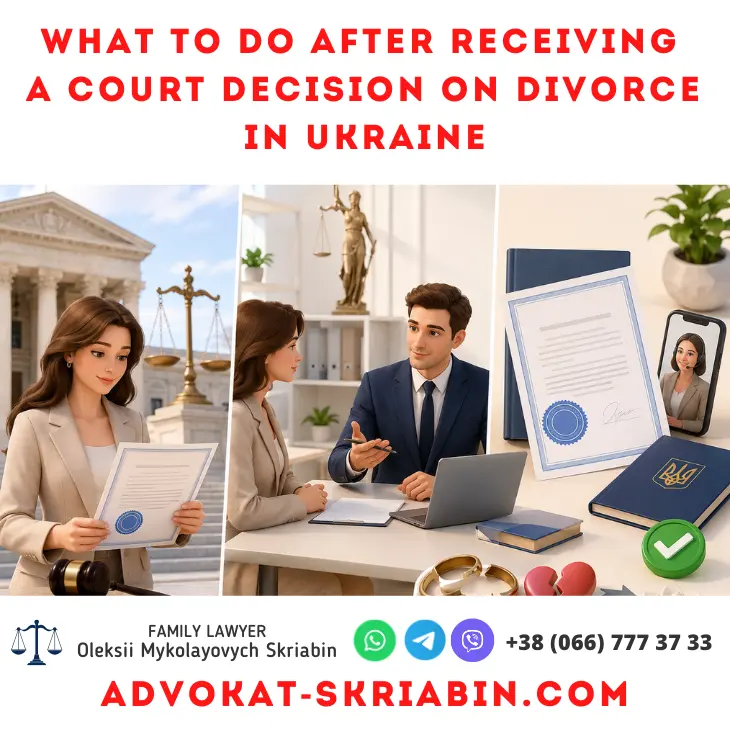

What Happens After a Court Decision on Divorce in Ukraine
After the court issues a divorce decision, the marriage is not always considered legally terminated immediately. The legal consequences depend on whether the decision has entered into force and whether any appeals are filed.
For many people searching for what to do after receiving a court decision on divorce in Ukraine, the first priority is understanding the legal status of the decision. Until the decision becomes final, certain actions may be premature, including remarrying or using the document abroad.
The court decision serves as official confirmation that the court has resolved the divorce case. However, additional administrative actions may still be necessary depending on your circumstances, especially if you need updated documents, international recognition, or surname changes.
If the divorce case has already been completed, it is important to understand how a court decision on divorce affects your future legal status, personal documents, and ability to use Ukrainian documents in other jurisdictions. It is also important to keep several copies of all divorce-related documents because they may be required later when dealing with banks, migration authorities, employers, or foreign institutions.
When Does a Divorce Court Decision Become Legally Effective
One of the most common questions is: when does a divorce court decision become final? In Ukraine, a divorce court decision generally becomes legally effective after the expiration of the period allowed for appeal, provided no appeal has been submitted. If an appeal is filed, the legal status of the decision depends on the outcome of appellate proceedings.
Many people mistakenly assume that the date printed on the decision is the date the divorce becomes final. In practice, the legally effective date may be different. Before taking further steps, it is advisable to verify that the court decision has entered into force. This is particularly important if you intend to remarry, use the document abroad, or update official records.
A legally effective court decision becomes the primary document confirming the termination of the marriage. General legislative provisions related to family and procedural matters can be checked through the official portal of the Verkhovna Rada of Ukraine, especially when it is necessary to verify current legal norms.
Court Decision on Divorce: What Are the Next Steps
People frequently ask: court decision on divorce what next? The answer depends on your individual situation. Some individuals need only retain the decision for their records. Others must obtain certified copies, register information with authorities, update personal documents, or arrange for apostille and translation services.
Step-by-Step Guide
- Confirm that the court decision has become legally effective.
- Obtain a certified copy of the decision if required.
- Determine whether you need an extract confirming divorce registration.
- Update personal documents if your surname or personal information changes.
- Arrange apostille and translation procedures if the document will be used abroad.
- Verify information in all official records and documents.
- Seek legal assistance if errors or complications arise.
For those wondering after divorce through court what to do, following these steps usually prevents future administrative difficulties.
How to Obtain a Certified Copy of a Divorce Court Decision
A certified copy may be required for various legal and administrative purposes. Government institutions, foreign authorities, and other organizations often request an officially certified version rather than a simple photocopy.
If you need how to get a copy of a divorce court decision, you can usually request it from the court that considered the divorce case. The procedure depends on the court’s internal administrative practices. Individuals living abroad frequently need certified copies because foreign authorities often require original court documentation.
If you do not have the required certified copy or need the document for submission to another institution, a properly organized request to obtain a court decision on divorce can help avoid delays and repeated applications. It is recommended to request additional certified copies if you anticipate future legal procedures involving immigration, remarriage, property matters, or recognition of Ukrainian documents abroad.
Can You Get a Divorce Court Decision Online
Modern digital systems have significantly improved access to court information in Ukraine. Many court documents can be viewed through official judicial electronic services. However, access to specific documents and the ability to obtain official copies online may depend on procedural and technical requirements.
People searching how to get a copy of a divorce court decision online should understand that electronic access does not always replace the need for a certified paper document. For Ukrainians residing abroad, online access can be particularly valuable because it allows them to monitor the status of their case without traveling to Ukraine.
Do You Need to Visit the Civil Registry Office After Divorce
Many people ask: do you need to visit the civil registry office after divorce? The answer depends on the purpose for which you need confirmation of the divorce. In many situations, the legally effective court decision is sufficient proof that the marriage has been terminated.
However, some individuals choose to obtain additional confirmation from the Civil Registry Office, especially if they need documentation for foreign authorities, administrative procedures, or personal records.
Ukrainian citizens living abroad often encounter requests from foreign institutions asking for documents that clearly confirm the registration of divorce. In such situations, obtaining additional official documentation may simplify future procedures.
If the divorce decision must be additionally reflected in civil status records, the issue of registration of a court decision upon divorce in the Civil Registry Office should be assessed according to the purpose for which the document will later be used. If you are uncertain whether a visit is necessary, legal advice can help determine which documents will be accepted by the institution requesting them.
How to Obtain an Extract Confirming Divorce Registration
Another common question is how to obtain an extract confirming divorce registration. An extract confirming divorce registration may be required by government institutions, foreign authorities, immigration offices, banks, or other organizations that need official confirmation of marital status.
The procedure usually involves submitting a request to the appropriate Civil Registry Office and providing identification documents. Depending on the circumstances, additional supporting documents may also be required.
For Ukrainians who live abroad, obtaining an extract can be especially useful when dealing with visa applications, residence permits, foreign courts, inheritance matters, or family law proceedings. Because requirements vary between countries, it is advisable to verify exactly which document is needed before starting the application process.
What Documents Should Be Updated After Divorce
After divorce, many people focus only on the court decision and forget about updating other important documents. When considering documents after divorce through court, it is important to review all records that may contain marital status information, previous surnames, or family details.
These may include identity documents, tax records, banking information, employment records, educational certificates, insurance documents, immigration files, and other official records. Failure to update relevant documents can lead to administrative complications later, especially when applying for visas, opening bank accounts, registering property rights, or interacting with foreign authorities.
If foreign institutions request proof of marital status after divorce, a certificate of marital status may be relevant depending on the country, institution, and purpose of submission. It is generally advisable to review all important documents soon after the divorce becomes legally effective.
How to Change Your Surname After Divorce in Ukraine
Many individuals wish to restore their previous surname after divorce. Changing a surname is a separate administrative procedure and is not always completed automatically when the marriage is dissolved. The specific steps depend on personal circumstances and the documents involved.
Before starting the process, it is important to decide whether you wish to keep your marital surname or return to a previous surname. Both options are legally available in many situations. After the surname change is completed, additional documents may require updating to ensure consistency across all official records. People living abroad should pay particular attention to immigration records and foreign identity documents to avoid discrepancies.
Can You Remarry After Receiving a Divorce Court Decision
A new marriage can only be registered after the previous marriage has been legally terminated. This is why understanding when does a divorce court decision become final is so important. The right to remarry generally arises only after the divorce decision has entered into legal force.
Before planning a new marriage, it is advisable to verify that all legal requirements have been satisfied and that the relevant documents are available. Foreign authorities may also request proof that the previous marriage was legally dissolved before recognizing a subsequent marriage. Proper documentation can help prevent delays and complications during future marriage registration procedures.
How to Use a Ukrainian Divorce Decision Abroad
Many Ukrainians who live outside Ukraine need to use their divorce documents in another country. A Ukrainian court decision on divorce may be required for immigration procedures, remarriage, inheritance matters, property transactions, child-related proceedings, or recognition of marital status. Different countries apply different rules regarding foreign documents. Therefore, a document accepted in one country may require additional formalities in another.
Before submitting the document abroad, it is important to determine whether legalization, apostille, translation, certification, or additional procedures are required. When divorce documents must be submitted outside Ukraine, legalization and apostille of Ukrainian documents for use abroad may be necessary before the document is accepted by a foreign authority. Obtaining the correct documentation from the beginning can save considerable time and expense later.
Apostille and Translation of a Divorce Court Decision
One of the most frequently requested services involves apostille for a divorce court decision. An apostille confirms the authenticity of an official document for use in countries that recognize the apostille system. Many foreign authorities will not accept a Ukrainian divorce court decision without proper authentication. In addition to apostille procedures, certified translation is often required. The translation must accurately reflect all information contained in the original court decision.
Because each country has its own document requirements, it is advisable to verify what form of authentication is necessary before beginning the process. If the document is intended for foreign use, an apostille of a court decision on divorce should be prepared carefully, since mistakes in names, dates, or certification may cause rejection abroad. Proper apostille and translation procedures can significantly reduce the risk of rejection by foreign authorities.
What to Do If There Is a Mistake in the Court Decision
Errors occasionally occur in court documents. Mistakes may involve names, dates, identification details, places of birth, document numbers, or other important information. Even a minor error can create serious difficulties when dealing with government agencies, banks, foreign institutions, or immigration authorities.
If you discover a mistake, it is important to address the issue promptly. Depending on the nature of the error, corrective procedures may be available through the court. Delaying correction may result in additional complications when the document is needed in the future.
What If You Lost Your Divorce Court Decision
Losing important legal documents is stressful, but it does not mean the information is permanently lost. If the original decision has been misplaced, damaged, or destroyed, it is generally possible to obtain another certified copy through the appropriate procedures.
Individuals living abroad often discover that they no longer possess their original documents when preparing immigration or family law applications. Fortunately, replacement documentation can often be obtained even years after the divorce. The sooner action is taken, the easier it is to avoid delays in future legal or administrative matters. Keeping digital copies and securely storing certified documents can help prevent future problems.
Legal Assistance After Receiving a Divorce Court Decision
Many people assume that legal assistance is no longer necessary after the court has granted the divorce. In reality, post-divorce issues often create new challenges. People may require help obtaining certified copies, correcting mistakes, changing surnames, obtaining extracts, preparing apostille documentation, arranging translations, or using Ukrainian divorce documents abroad.
For Ukrainians residing outside Ukraine, professional assistance can simplify communication with courts, Civil Registry Offices, and other authorities. If representation is required, it is important to remember: A lawyer represents the client’s interests on the basis of a legal assistance agreement, which may be concluded online. A power of attorney is not required for this purpose.
In complex post-divorce situations, a family lawyer consultation can help determine whether you need a certified copy, an extract, apostille, translation, correction of a court decision, or additional confirmation for use abroad. An online divorce service may also assist clients with post-divorce procedures, helping ensure that all required documents are obtained and properly prepared.
Phone / Viber / WhatsApp / Telegram: +380667773733
Email: skriabinadvokat@gmail.com