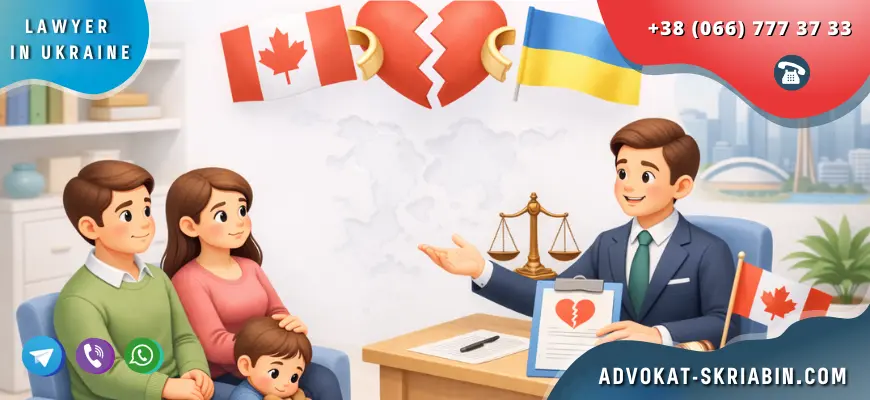
- What Is the Divorce Procedure in Canada for Ukrainians
- Who Can Apply for Divorce in Canada
- How to File for Divorce in Canada as a Ukrainian Citizen
- Can You Get a Divorce in Canada Online
- Divorce in Canada Without the Presence of a Spouse
- Can You Divorce Without Your Husband’s or Wife’s Consent
- Documents Required for Divorce in Canada
- How Long Does a Divorce in Canada Take
- How Much Does Divorce Cost in Canada
- Divorce in Canada If You Have Children
- Child Custody and Child Support After Divorce in Canada
- Property Division After Divorce in Canada
- Recognition of a Canadian Divorce in Ukraine
- Divorce Between a Ukrainian Citizen and a Canadian Citizen
- Why Hire a Family Lawyer for Divorce in Canada
- Step-by-Step Guide: How a Ukrainian Can Get Divorced in Canada

What Is the Divorce Procedure in Canada for Ukrainians
The divorce procedure in Canada is governed by federal and provincial family law rules. Although legal requirements may differ slightly between provinces, the general process remains similar throughout the country. A court reviews the application, verifies jurisdiction, examines issues involving children and finances when necessary, and ultimately grants a divorce order.
For many Ukrainian citizens, the first concern is determining whether Canada has jurisdiction over their marriage. In most situations, Canadian courts may consider a divorce case if one spouse has established the required period of residence within the province where the application is filed.
A divorce in Canada for Ukrainians may be straightforward when both spouses agree to end the marriage and have already resolved issues involving property and children. However, when disagreements exist, the process may become more complex and require additional court involvement.
International family matters often create additional questions regarding foreign documents, translations, immigration status, and the future recognition of Canadian divorce in Ukraine. Understanding these issues from the beginning can help avoid delays and unnecessary expenses.
Who Can Apply for Divorce in Canada
A person does not need to be a Canadian citizen to seek a divorce in Canada. In many cases, permanent residents, temporary residents, refugees, and foreign nationals may also have access to Canadian family courts if the residency requirements established by provincial law are satisfied.
This is particularly important for Ukrainian citizens divorce in Canada situations. Many Ukrainians arrived in Canada through temporary protection programs, work permits, or other immigration pathways. Their immigration category does not automatically prevent them from applying for divorce if jurisdictional requirements are met.
A spouse may apply individually or together with the other spouse. Joint applications are generally used when both parties agree that the marriage should end and there are no major disputes requiring judicial intervention.
Before filing documents, it is advisable to verify the specific rules of the province where the application will be submitted. Jurisdictional mistakes are among the most common reasons for delays in international family law cases.
How to File for Divorce in Canada as a Ukrainian Citizen
The process usually begins with preparing the necessary court documents and determining which court has jurisdiction over the case. The applicant must provide information regarding the marriage, the spouses, any children of the marriage, and relevant financial circumstances.
When dealing with Ukrainian citizens divorce in Canada, additional documentation may sometimes be required. Marriage certificates issued in Ukraine may need certified translations depending on provincial requirements. Courts may also request supporting documents concerning residency and family circumstances.
Many applicants prefer to organize their paperwork carefully before filing. Errors in names, dates, addresses, or translations can significantly slow down proceedings and create unnecessary requests from the court.
If legal representation is used, the process can often become more manageable. It is important to remember that international family disputes frequently involve both Canadian and Ukrainian legal considerations, especially when future recognition of court decisions is expected.
Can You Get a Divorce in Canada Online
In many situations, an online divorce in Canada is possible. Canadian courts increasingly use electronic filing systems, remote communications, and digital document management, making it easier for parties to participate without attending court in person.
An online process is particularly helpful for Ukrainians who live far from the court location, frequently travel between countries, or face practical difficulties attending hearings. Depending on the circumstances of the case, some procedural steps may be completed remotely.
However, the term online divorce in Canada does not always mean that every stage is fully digital. The exact procedure depends on the province, court requirements, and whether disputes concerning children, support, or property exist.
Where legal assistance is involved, much of the communication, document preparation, and case management can usually be handled remotely. This significantly reduces stress and allows spouses to focus on resolving important family issues rather than administrative formalities. For Ukrainians who need a remote legal model, online divorce support can be useful when documents and communication must be organized without personal attendance.
Divorce in Canada Without the Presence of a Spouse
Many Ukrainians are concerned about situations where one spouse remains in another country or refuses to participate. In practice, a divorce without presence in Canada may be possible under certain circumstances if procedural requirements regarding notification and service of documents are satisfied.
Courts generally focus on ensuring that the other spouse receives proper notice of the proceedings and has an opportunity to respond. If those requirements are met, the absence of one party does not necessarily prevent the case from moving forward.
This issue frequently arises in cases involving international marriages where one spouse lives in Canada and the other remains in Ukraine or another country. Proper service of documents becomes especially important in these situations.
When handled correctly, distance alone does not automatically block a divorce. Courts regularly address cross-border family disputes and have established procedures for international notification and participation. Similar legal logic may arise when a person needs divorce without personal presence and wants to reduce unnecessary travel or court attendance.
Can You Divorce Without Your Husband’s or Wife’s Consent
A common misconception is that both spouses must agree before a marriage can legally end. In reality, a divorce in Canada may still proceed even if one spouse opposes the decision or refuses to cooperate.
Canadian family law recognizes that a marriage may break down despite the wishes of one party. Courts generally focus on whether legal grounds for divorce exist rather than requiring mutual consent.
Disagreements may affect the duration and complexity of proceedings, particularly when disputes involve parenting arrangements, financial support, or property division. Nevertheless, refusal to consent does not automatically prevent a divorce order from being issued.
For Ukrainians facing an uncooperative spouse, understanding this principle is often reassuring. The legal process provides mechanisms that allow cases to move forward while protecting the procedural rights of both parties. In cross-border family cases, the situation may be close in meaning to divorce without the other spouse’s consent, where the court procedure continues even when one party disagrees.
Documents Required for Divorce in Canada
The documents required for a divorce in Canada for Ukrainians depend on the province where the application is submitted and the specific circumstances of the marriage. Nevertheless, several categories of documents are commonly requested by Canadian courts.
The most important document is usually the marriage certificate. If the marriage was registered in Ukraine, the court may require a certified translation into English or French. Additional documents may include proof of residency, identification documents, and information concerning children or financial obligations.
When spouses have children, courts often request information regarding parenting arrangements, child support, and the current living situation of the children. If property issues are involved, financial disclosure may also be required.
Preparing documents carefully from the beginning reduces the risk of delays. Incorrect translations, incomplete forms, or inconsistent information are among the most frequent reasons family court cases take longer than expected. For Ukrainian citizens, it is also important to understand which documents for divorce may be needed if the case later has to be confirmed or continued in Ukraine.
How Long Does a Divorce in Canada Take
The duration of a divorce procedure in Canada varies depending on whether the divorce is contested or uncontested. Cases where both spouses agree generally move faster than disputes involving property, child custody, or financial support.
Several factors may influence timing, including court workload, document preparation, service of documents, and the willingness of both spouses to cooperate. International family matters sometimes require additional procedural steps, particularly when one spouse resides outside Canada.
For Ukrainians involved in cross-border family matters, delays may occur when foreign documents require translation or when documents must be delivered internationally. However, proper preparation can significantly reduce potential complications. It is important to understand that every case is unique. Comparing one family’s timeline with another may create unrealistic expectations because courts evaluate each situation individually.
How Much Does Divorce Cost in Canada
The cost of a divorce in Canada depends on many variables, including court fees, document preparation, translation expenses, legal representation, and the complexity of the dispute. An uncontested divorce is generally less expensive because fewer court appearances and legal procedures are required. Cases involving property division, child custody disputes, or international issues usually involve higher costs due to the additional legal work necessary.
For divorce between Ukraine and Canada situations, expenses may also include document legalization, certified translations, obtaining records from foreign authorities, and advice regarding recognition of court decisions abroad.
Rather than focusing solely on cost, it is often beneficial to consider the overall value of proper legal preparation. Mistakes made during the divorce process can result in significantly greater expenses later.
Divorce in Canada If You Have Children
When children are involved, Canadian courts place the child’s best interests at the center of all decisions. The goal is not simply to end the marriage but also to ensure stability, safety, and appropriate parenting arrangements after separation.
A divorce in Canada for Ukrainians involving children requires careful consideration of living arrangements, education, healthcare, communication with both parents, and financial support obligations.
Parents are encouraged to cooperate whenever possible and focus on practical solutions that support the child’s development. Courts generally appreciate efforts to resolve parenting issues constructively rather than through conflict. International families may face additional questions regarding travel, relocation, and communication across borders. These matters should be addressed clearly to prevent future disputes.
Child Custody and Child Support After Divorce in Canada
Questions regarding children are often the most emotionally difficult part of a family dispute. Canadian courts prioritize the welfare of the child and seek arrangements that support healthy relationships with both parents whenever appropriate.
Child custody decisions focus on factors such as stability, caregiving history, educational needs, emotional well-being, and the child’s overall best interests. Each family’s circumstances are assessed individually rather than through a universal formula. Financial support remains an important responsibility after separation. Child support obligations generally continue regardless of whether parents maintain a positive relationship with each other.
For many families experiencing a divorce between Ukraine and Canada, additional planning may be necessary regarding international travel, communication across countries, and long-term parenting arrangements when parents reside in different jurisdictions. If the child has ties with Ukraine, questions of child custody after divorce.
Property Division After Divorce in Canada
Property division is one of the most significant financial aspects of a divorce procedure in Canada. The rules governing division may vary depending on the province and the specific circumstances of the spouses.
Courts generally consider assets accumulated during the marriage, financial contributions of each spouse, debts, and other relevant factors. The objective is to achieve a fair result under applicable law.
For Ukrainians who own assets in multiple countries, property issues may become particularly complex. Real estate located in Ukraine, bank accounts held abroad, investments, or business interests may require careful legal analysis. International property disputes often involve questions concerning jurisdiction and enforcement. Early legal advice can help prevent misunderstandings and reduce the likelihood of future litigation.
Recognition of a Canadian Divorce in Ukraine
One of the most important questions for Ukrainians who end their marriage abroad concerns the recognition of Canadian divorce in Ukraine. Although a divorce may be legally valid in Canada, additional actions can sometimes be necessary before the decision can be fully used within Ukraine.
Recognition may become relevant when a person plans to remarry in Ukraine, update civil status records, resolve inheritance matters, change documents, or confirm family status before Ukrainian authorities. The exact procedure depends on the circumstances of the case and the nature of the Canadian court decision.
In many situations, Ukrainian authorities need properly prepared copies of the Canadian divorce documents together with certified translations. Additional legalization procedures may also be required depending on the specific document involved. For civil status, apostille, and registration-related issues, information from the Ministry of Justice of Ukraine may be relevant when preparing documents for use in Ukraine.
Because international family matters can be complex, it is advisable to analyze the Canadian divorce decision before taking further steps in Ukraine. Proper preparation helps avoid delays and repeated requests from government authorities. In practice, this often relates to recognition in Ukraine of a foreign divorce decision, especially when the Canadian judgment must be used before Ukrainian institutions.
Divorce Between a Ukrainian Citizen and a Canadian Citizen
A divorce between Ukraine and Canada often involves legal issues that do not arise in purely domestic cases. The spouses may have different citizenships, reside in different countries, own assets in multiple jurisdictions, or have children who regularly travel between countries.
One of the first issues is determining which court has jurisdiction over the divorce. Depending on the circumstances, proceedings may potentially take place in Canada, while certain related issues could still require attention under Ukrainian law.
Cross-border marriages frequently involve questions regarding child relocation, international travel permissions, property ownership abroad, and enforcement of court decisions. Each of these issues requires careful analysis.
Despite these additional challenges, thousands of international families successfully complete the divorce process every year. Early legal planning often prevents conflicts and allows both parties to move forward with greater certainty.
Why Hire a Family Lawyer for Divorce in Canada
Although some divorces proceed without significant disputes, professional legal assistance can be particularly valuable when international elements are involved. A family lawyer in Canada can help identify potential risks before they become serious legal problems.
This is especially important for divorce in Canada for Ukrainians, where questions of foreign documents, translations, international jurisdiction, child-related matters, and future recognition in Ukraine frequently arise.
A qualified divorce lawyer in Canada may assist with document preparation, negotiations, court procedures, settlement agreements, and communication with relevant authorities. Legal guidance can often reduce stress and help avoid procedural mistakes. When Ukrainian law issues remain connected to the case, a family lawyer consultation may help determine what actions are required in Ukraine after the Canadian divorce.
Where representation is necessary, it is important to remember that A lawyer represents the client’s interests on the basis of a legal assistance agreement, which can be concluded online. A power of attorney is not required for this.
Step-by-Step Guide: How a Ukrainian Can Get Divorced in Canada
- Determine whether a Canadian court has jurisdiction over your case and whether you meet the residency requirements.
- Prepare all necessary documents, including the marriage certificate, documents concerning children, and proof of residence.
- If necessary, arrange an official translation of Ukrainian documents into English or French.
- Submit the documents to the appropriate court or use available tools for online divorce in Canada.
- Ensure proper notification of the other spouse about the divorce proceedings.
- Resolve issues concerning children, child support, and property, or prepare for their court consideration.
- After receiving the divorce decision, check whether the recognition of Canadian divorce in Ukraine is required if you plan to use the decision in Ukraine.
Phone / Viber / WhatsApp / Telegram: +380667773733
Email: skriabinadvokat@gmail.com