
- What Is an Application for Adoption of a Child in Ukraine
- Who Can File an Application for Adoption
- Where to Submit an Adoption Application in Ukraine
- Documents Required for Adoption of a Child
- How to Prepare an Application for Adoption Correctly
- Application for Adoption by a Stepfather or Stepmother
- Adoption of a Spouse’s Child: Special Legal Requirements
- Role of the Guardianship and Custody Authority in Adoption Cases
- Court Procedure for Adoption of a Child in Ukraine
- Consent of the Child and Other Persons for Adoption
- Common Mistakes When Filing an Adoption Application
- When Can a Court Refuse an Adoption Request
- Court Decision on Adoption and Its Legal Effect
- Registration of Adoption After the Court Decision
- Lawyer Assistance with Adoption Proceedings in Ukraine
- Step-by-Step Guide
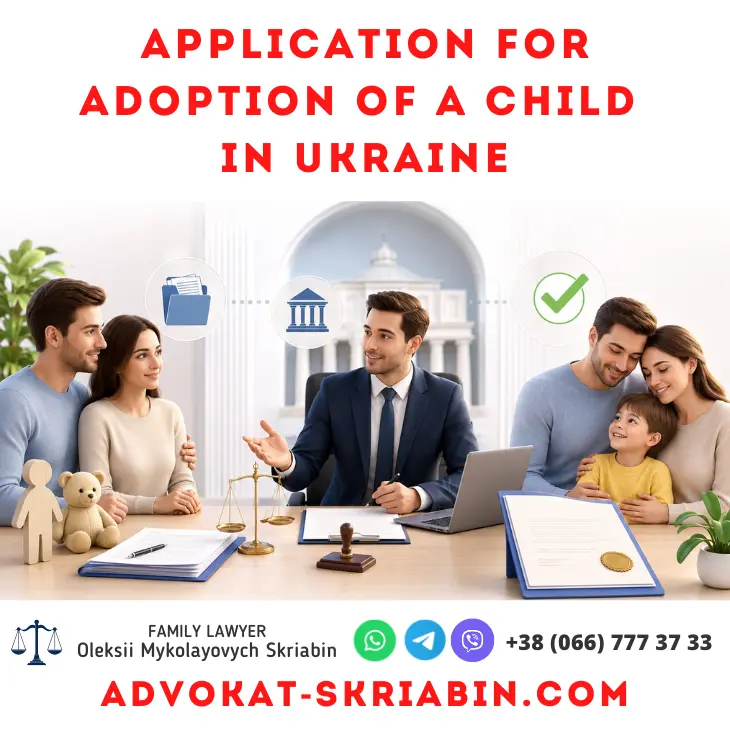
What Is an Application for Adoption of a Child in Ukraine
An application for adoption of a child in Ukraine is a formal legal document submitted to a court requesting recognition of a family relationship between the adopter and the child. The application serves as the foundation of the entire adoption process and contains information about the applicant, the child, and the circumstances supporting the adoption request.
The purpose of the application for adoption is not merely administrative. The court must determine whether the adoption is in the best interests of the child and whether all statutory requirements have been satisfied. For this reason, the document must be complete, accurate, and supported by appropriate evidence.
When preparing an application for adoption of a child in Ukraine, applicants should clearly explain their relationship with the child, their family situation, financial stability, living conditions, and motivation for adoption. Courts pay particular attention to factors that may affect the child’s welfare and long-term development.
The legal adoption of a child in Ukraine creates legal rights and obligations similar to those existing between biological parents and children. After adoption is completed, the child receives full legal status within the adoptive family.
Who Can File an Application for Adoption
Ukrainian legislation establishes specific requirements regarding who may become an adoptive parent. Individuals seeking adoption must satisfy conditions related to age, legal capacity, health, and personal suitability.
A married person may file an application for adoption independently or jointly with a spouse, depending on the circumstances. In many cases, spouses adopt together, particularly when adopting a child who is not biologically related to either spouse.
A separate category includes adoption of spouse’s child. This situation often arises when a stepparent has established a close parental relationship with a child and wishes to formalize that relationship legally. Such cases generally involve additional documentation regarding the child’s biological parent.
Foreign citizens and Ukrainians living abroad may also pursue adoption of a child in Ukraine, provided they comply with Ukrainian legal requirements and international procedures where applicable. In cross-border cases, the conditions for adopting a child by foreigners should be assessed before documents are submitted.
Where to Submit an Adoption Application in Ukraine
An adoption application to court is generally submitted to the competent court that has jurisdiction over the child’s place of residence or other circumstances established by procedural law. Before filing the application, prospective adoptive parents should ensure that all required documents have been collected and properly prepared. Missing documents frequently cause delays and additional requests from the court.
The court is responsible for examining evidence, hearing relevant participants, reviewing the conclusions of the guardianship authority, and determining whether adoption serves the best interests of the child. Current procedural information and applicable norms may be checked through Ukrainian family legislation, including rules that regulate family relations, court procedures, and child protection.
For applicants residing abroad, the filing process may involve additional procedural steps. Nevertheless, many preparatory actions can be completed remotely before documents are submitted to the court.
Documents Required for Adoption of a Child
One of the most important stages of the process involves gathering documents for adoption of a child. Courts carefully review documentary evidence to verify compliance with legal requirements. Although the specific list may vary depending on the circumstances, applicants are typically required to provide identity documents, information regarding marital status, medical certificates, evidence of income, proof of residence, and documents relating to the child.
Particular attention should be paid to document validity and consistency. Even minor discrepancies between records may result in requests for clarification or additional evidence. For Ukrainians living abroad, foreign documents may require translation into Ukrainian and, depending on the country of issuance, legalization or apostille procedures before they can be accepted by Ukrainian authorities.
How to Prepare an Application for Adoption Correctly
Preparing an application for adoption requires more than simply completing a form. The document must present a coherent legal and factual basis demonstrating why adoption is appropriate and beneficial for the child.
The application should describe the applicant’s family situation, relationship with the child, housing conditions, financial circumstances, and readiness to assume parental responsibilities. Supporting documents should correspond to the information contained in the application.
Errors in names, dates, addresses, or family information frequently create procedural complications. Therefore, every section should be reviewed carefully before submission. When an applicant asks how to adopt a child in Ukraine, one of the most practical recommendations is to ensure that the application is professionally structured from the outset. A properly prepared application often reduces procedural delays and additional court inquiries.
Application for Adoption by a Stepfather or Stepmother
Stepfather adoption in Ukraine is one of the most common categories of adoption proceedings. These cases arise when a child lives with a biological parent and a stepparent who has effectively assumed parental responsibilities.
In such situations, adoption provides legal certainty and strengthens family stability. It also grants the child rights and protections associated with a legally recognized parent-child relationship. The court will examine not only legal documents but also the actual relationship between the child and the stepparent. Evidence demonstrating a stable family environment may significantly influence the outcome of the proceedings. Where necessary, the court may also consider the views of the child and other participants involved in the case.
Adoption of a Spouse’s Child: Special Legal Requirements
The adoption of spouse’s child differs from many other adoption cases because a pre-existing family relationship already exists. The child usually resides within the household of the prospective adoptive parent before the adoption application is filed.
Despite this family connection, legal requirements remain important. The court must verify compliance with procedural rules, evaluate the child’s interests, and ensure that all necessary consents have been obtained.
Issues involving parental rights of the biological parent who is not raising the child often require particular attention. Depending on the circumstances, additional legal analysis may be necessary before the application is submitted. For many families, adoption of spouse’s child provides long-term legal protection and simplifies future matters involving inheritance, parental authority, travel, education, and healthcare decisions.
Role of the Guardianship and Custody Authority in Adoption Cases
The guardianship and custody authority plays a central role in adoption proceedings. Before the court makes a final decision, the authority evaluates circumstances relevant to the child’s welfare and prepares a conclusion for the court.
Representatives of the authority may examine living conditions, interview applicants, review documents, and gather information about the family environment. Their assessment helps the court understand whether adoption would serve the child’s best interests.
Although the court is not automatically bound by the authority’s conclusions, such findings usually carry significant evidentiary value. Courts carefully review these materials during the hearing. Applicants should cooperate openly and provide complete information during the evaluation process. Transparency and consistency often contribute to a smoother review of the adoption case.
Court Procedure for Adoption of a Child in Ukraine
The court adoption procedure is the final and most important stage of the adoption process. After the application and supporting documents are submitted, the court examines all materials and determines whether the proposed adoption complies with the child’s best interests.
During the proceedings, the court reviews the adoption application to court, evaluates the conclusion of the guardianship authority, examines evidence provided by the applicant, and verifies that all legal requirements have been satisfied. Depending on the circumstances, the court may also hear explanations from other participants involved in the case.
Unlike many civil disputes, adoption proceedings focus primarily on the welfare of the child rather than competing interests between parties. The judge carefully assesses whether the future family environment will provide stability, security, and proper conditions for the child’s development. When all legal requirements are met and the court concludes that adoption serves the child’s interests, a decision approving the adoption is issued.
Consent of the Child and Other Persons for Adoption
Consent is one of the most significant elements of adoption proceedings. Ukrainian law requires courts to verify whether all necessary permissions and approvals have been properly obtained before granting adoption.
Depending on the circumstances, consent may be required from biological parents, guardians, custodians, institutions responsible for the child, or other legally authorized persons. The court evaluates whether such consent has been given voluntarily and in accordance with legal requirements.
The opinion of the child may also be considered when the child’s age and level of maturity make it appropriate. Courts recognize that a child should not merely be treated as the subject of proceedings but as a participant whose interests deserve protection. Failure to obtain required consent can create serious legal obstacles and may result in refusal of the adoption request.
Common Mistakes When Filing an Adoption Application
Many adoption cases encounter delays because applicants underestimate the importance of procedural accuracy. Even where a family has strong grounds for adoption, technical errors may complicate the process.
One of the most common mistakes is submitting incomplete documents for adoption of a child. Missing certificates, inconsistencies in personal information, or improperly prepared translations frequently lead to additional requests from the court.
Another frequent problem involves insufficient explanation of the applicant’s relationship with the child. Courts need a clear understanding of the family situation and the reasons why adoption is appropriate.
Applicants also sometimes assume that stepfather adoption in Ukraine or adoption of spouse’s child is merely a formality. In reality, these cases still require careful compliance with legal procedures and evidentiary requirements.
When Can a Court Refuse an Adoption Request
Although courts generally support adoption when it benefits a child, approval is never automatic. Each case undergoes an individual legal assessment. A refusal may occur if statutory requirements are not satisfied, required consent is absent, documents contain significant deficiencies, or evidence suggests that adoption would not serve the child’s interests.
Courts may also refuse an application when concerns arise regarding the applicant’s ability to provide appropriate care, maintain a stable family environment, or fulfill parental responsibilities. Importantly, a refusal does not always mean that adoption is permanently impossible. In some situations, deficiencies can be corrected and a new application may later be submitted after legal issues have been resolved.
Court Decision on Adoption and Its Legal Effect
Once the court approves the adoption of a child in Ukraine, the decision creates a new legal relationship between the adoptive parent and the child. From that moment, rights and obligations generally correspond to those existing between biological parents and children.
The court decision approving adoption serves as the legal foundation for subsequent registration procedures and official record updates. It may also affect issues involving inheritance, parental authority, maintenance obligations, and family status.
Following adoption, the child becomes a full member of the adoptive family with the same legal protections and rights afforded under Ukrainian law. Parties should carefully review the court decision and ensure that all required post-judgment procedures are completed correctly.
Registration of Adoption After the Court Decision
The adoption process does not end immediately after the court issues its decision. Additional registration actions are necessary to formalize the legal changes resulting from adoption. Civil status records may require updating to reflect the newly established family relationship. Depending on the circumstances, amendments may also be made regarding the child’s surname, patronymic, or parental information.
Proper registration ensures consistency across official documents and reduces the likelihood of future legal complications. It also allows the child and adoptive parents to exercise their rights without administrative difficulties. At this stage, families should also remember that the confidentiality of adoption records may be legally important, especially when official documents are updated after the court decision.
Lawyer Assistance with Adoption Proceedings in Ukraine
Adoption proceedings involve numerous legal, procedural, and documentary requirements. Professional legal assistance can help applicants avoid mistakes and significantly simplify the process. An adoption lawyer in Ukraine may assist with document preparation, legal analysis, communication with authorities, preparation of the application for adoption, and representation during court proceedings.
For Ukrainian citizens residing abroad, legal support often becomes particularly valuable because of additional issues involving foreign documents, translations, legalization requirements, and remote coordination of the case.
A lawyer can also identify potential risks before documents are submitted, reducing the likelihood of procedural delays, refusal of the adoption request, or later disputes related to cancellation of adoption. Important: A lawyer represents the client’s interests on the basis of a legal assistance agreement, which may be concluded online. A power of attorney is not required for this purpose.
Step-by-Step Guide
- Determine whether you satisfy the legal requirements for adoption and collect preliminary information about the child.
- Obtain and prepare all documents required for adoption of a child, including supporting evidence regarding family and living conditions.
- Cooperate with the guardianship and custody authority and complete the necessary evaluations.
- Prepare a properly structured application for adoption of a child in Ukraine and gather all supporting materials.
- Submit the adoption application to court and participate in the required procedural stages.
- Obtain the court decision approving adoption and verify that all legal requirements have been fulfilled.
- Complete registration procedures and update official records following the adoption.
Phone / Viber / WhatsApp / Telegram: +380667773733
Email: skriabinadvokat@gmail.com